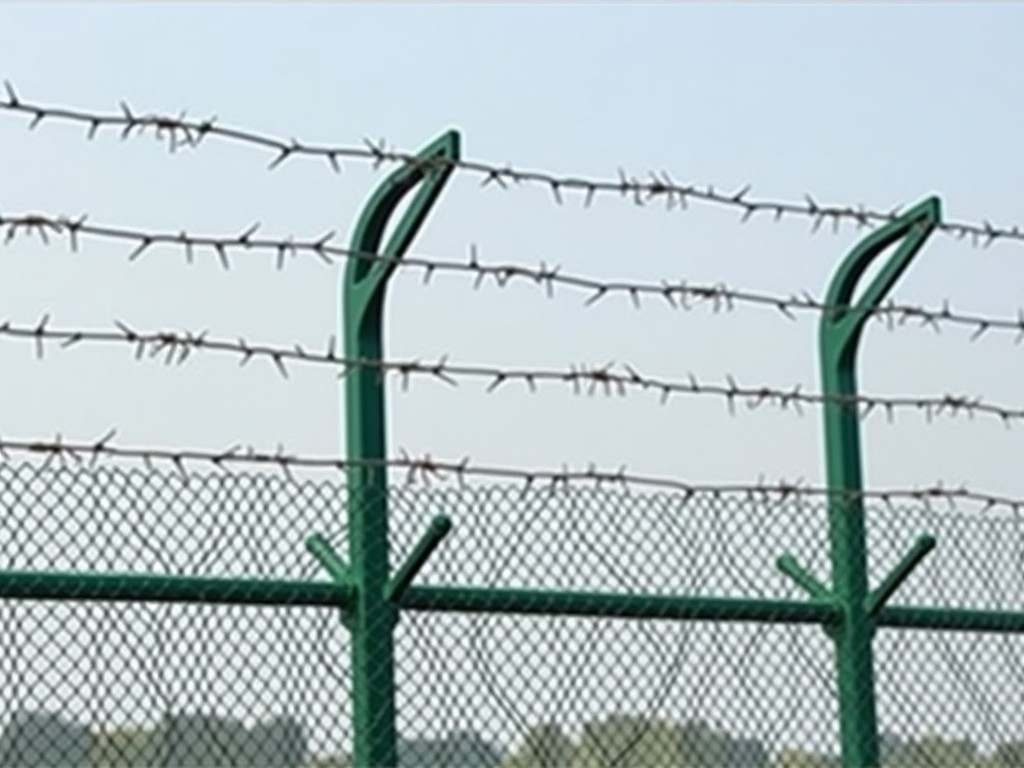
China Razor Wire And Barbed Wire Manufacturer
Razor wire and barbed wire are security fencing products formed by twisting steel wire with sharp protrusions. Razor wire uses flattened steel strips with barbs, while barbed wire consists of two
Request a QuoteChina Razor Wire And Barbed Wire Manufacturer
Product Overview
Razor wire and barbed wire are security fencing products formed by twisting steel wire with sharp protrusions. Razor wire uses flattened steel strips with barbs, while barbed wire consists of two strands twisted together with periodic barbs. Both products provide a physical deterrent through tensile strength and puncture resistance.
Typical applications include perimeter protection for industrial facilities, correctional institutions, military bases, and agricultural enclosures. The selection between razor and barbed wire depends on required security level, installation environment, and maintenance considerations.
Material and Construction
Core wire is typically low-carbon steel with a tensile strength ranging from 350 to 550 MPa. The wire is galvanized (hot-dip or electro-galvanized) to achieve a zinc coating weight of 60 to 275 g/m², providing corrosion resistance in outdoor environments. For heightened durability, PVC coating or stainless steel (grade 304 or 316) can be specified.
Razor wire strips are cold-rolled to a thickness of 0.5 to 0.8 mm, with barb lengths of 15 to 22 mm and spacing of 100 to 150 mm along the core. Barbed wire uses two 2.0 mm diameter strands twisted in opposite directions, with barbs formed from 1.6 mm wire, typically 15 mm long and spaced 75 to 100 mm apart.
Typical Specifications
| Parameter | Razor Wire (Typical) | Barbed Wire (Typical) | Unit |
|---|---|---|---|
| Core wire diameter | 2.0 - 2.5 | 2.0 (each strand) | mm |
| Tensile strength | 350 - 550 | 350 - 550 | MPa |
| Zinc coating weight | 60 - 275 | 60 - 275 | g/m² |
| Barb length | 15 - 22 | 12 - 18 | mm |
| Barb spacing | 100 - 150 | 75 - 100 | mm |
| Roll length (standard) | 20 - 50 | 20 - 50 | m |
Values shown are typical ranges; actual dimensions can be customized according to project requirements, including alternative coatings, stainless steel grades, or special barb geometries.
Applications
- Industrial perimeter fencing where high tensile strength and low maintenance are required.
- Correctional facility barriers needing puncture resistance and visual deterrence.
- Military base perimeters demanding rapid deployment and resistance to cutting tools.
- Agricultural livestock enclosures to deter predators while allowing visibility.
- Infrastructure protection for substations, water treatment plants, and telecommunications sites.
The product’s effectiveness stems from the combination of axial tensile load capacity and localized stress concentrations at barb tips, which impede climbing and cutting attempts without requiring active power.
Manufacturing Process
Production begins with drawing low-carbon steel wire to the specified diameter, followed by cleaning and annealing to achieve uniform mechanical properties. The wire then passes through a zinc bath (hot-dip) or electroplating line for corrosion protection.
For razor wire, the coated wire is slit and flattened, then stamped to form barbs before being wound onto a core. Barbed wire is produced by twisting two wires in opposite directions while simultaneously wrapping barb wire around them at set intervals.
In-line quality checks monitor diameter tolerance, coating weight, and barb geometry. Final coils are tension‑tested to verify tensile strength before packaging.
Quality Control Philosophy
Quality assurance follows a preventive approach: raw material certificates are verified, in‑process measurements are logged, and finished goods undergo statistical sampling. Key inspected items include wire diameter (±0.02 mm), coating adhesion (ASTM D3359), barb height uniformity (±1 mm), and tensile strength (≥350 MPa).
Non‑conforming material is segregated and re‑processed or scrapped according to defined procedures. Traceability is maintained via batch numbers linked to coil weight, production date, and inspection records.
Customization Options
- Alternative core materials: stainless steel 304, 316, or galvanized alloy.
- Coating types: hot‑dip zinc, zinc‑aluminum alloy, PVC, or powder coating.
- Barb geometry: length, angle, and spacing adjusted to meet specific threat levels.
- Roll length and inner diameter tailored to handling equipment.
- Printing or embossing of identification marks for inventory control.
Customization is coordinated during the quotation phase, where technical drawings or sample specifications are exchanged to confirm feasibility.
Packaging and Shipping
- Standard packaging: wooden pallets with stretch film and corner protectors.
- Moisture barrier: VCI‑treated paper or polyethylene film inside pallet wrap.
- Labeling: each pallet includes product code, length, weight, and batch number.
- Containerization: 20‑ft or 40‑ft palletized loads, secured with straps to prevent shifting.
Export shipments comply with ISPM‑15 for wooden packaging and include necessary documentation for customs clearance.
Frequently Asked Questions
Yes, wire diameter, barb length, spacing, and coil length can be adjusted based on application needs. Provide detailed requirements for a feasibility review.
Required data include: desired wire type (razor or barbed), material grade, coating preference, dimensions (diameter, barb length, spacing), total length or number of rolls, and any special packaging or labeling requests.
Standard low‑carbon steel with hot‑dip galvanization is typical. Optional upgrades include stainless steel (grades 304/316), zinc‑aluminum alloy coating, or PVC over‑coat for enhanced corrosion resistance.
In‑process checks monitor diameter, coating weight, and barb geometry. Final inspection includes tensile testing, coating adhesion test, and visual examination for defects. Sampling follows ANSI/ASQ Z1.4 standards.
Standard palletized packaging with stretch film and moisture barrier. Custom options include wooden crates, steel reels, or corrosion‑inhibitor treated wraps for specific environments.
Pallets are ISPM‑15 compliant, wrapped in UV‑stable polyethylene, and secured with steel strapping. Corner protectors and edge boards prevent mechanical damage during transit.
Lead time varies with order size and customization, typically ranging from 10 to 25 working days after receipt of confirmed technical details and deposit.
Samples of up to 5 meters can be provided free of charge, with freight collect or prepaid as agreed. Larger sample lengths may incur material and handling charges.
Contact for Inquiry
For technical consultation, custom specifications, or a formal quotation, please reach out via the contact form. Provide project details such as application, required dimensions, material preferences, and delivery timeline to enable a precise response.



