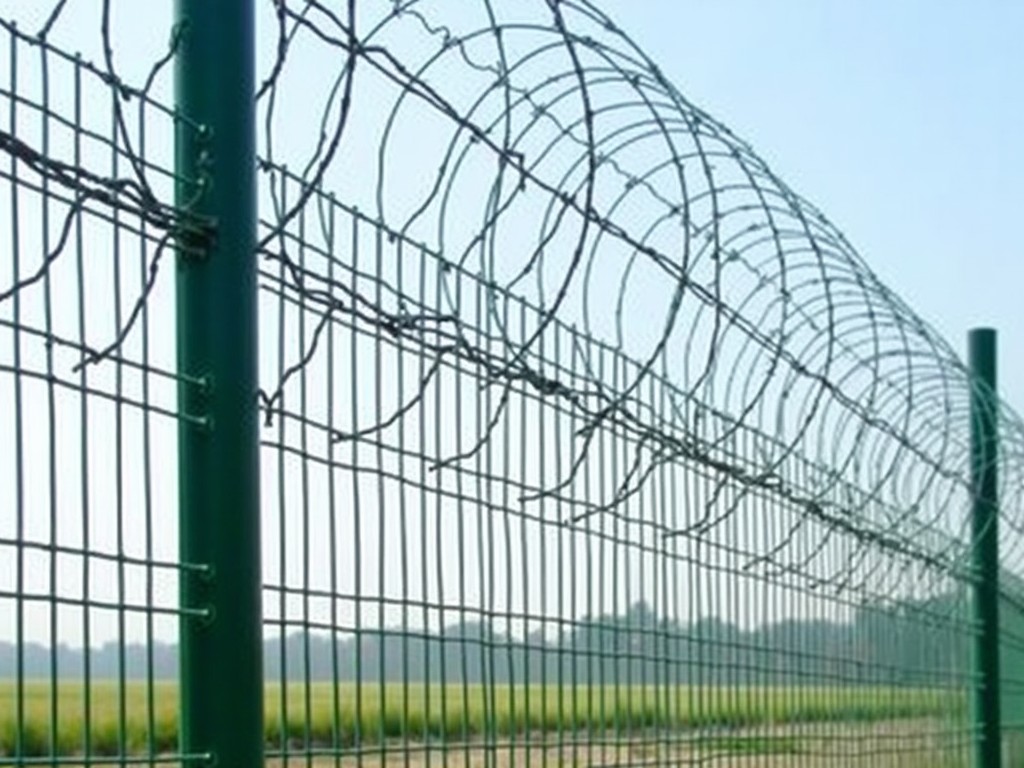
China High Tensile Barbed Wire Fencing Supplier
High tensile barbed wire fencing is fabricated from cold‑drawn steel wire that undergoes tensile strengthening to achieve yield strengths typically above 550 MPa. The wire is shaped into a helical
Request a QuoteChina High Tensile Barbed Wire Fencing Supplier
High tensile barbed wire fencing is fabricated from cold‑drawn steel wire that undergoes tensile strengthening to achieve yield strengths typically above 550 MPa. The wire is shaped into a helical core with uniformly spaced barbs that provide mechanical deterrence while maintaining flexibility for installation on posts or directly tensioned between anchors.
Key Technical Characteristics
The core wire diameter commonly ranges from 2.0 mm to 3.0 mm, directly influencing the breaking load. A 2.5 mm diameter wire with a tensile strength of 620 MPa yields a breaking load of approximately 3.0 kN per strand. Barb geometry is defined by barb length (typically 15 mm to 20 mm) and barb spacing (usually 75 mm to 150 mm), which determines the number of barbs per meter and the overall resistance to climbing or cutting.
- Wire diameters: 2.0 mm, 2.2 mm, 2.5 mm, 2.8 mm, 3.0 mm
- Tensile strength range: 500 MPa – 700 MPa (cold‑drawn high‑carbon steel)
- Zinc coating weight: 100 g/m² – 275 g/m² (hot‑dip galvanized) for corrosion protection
- Barb length: 15 mm, 18 mm, 20 mm
- Barb spacing: 75 mm, 100 mm, 125 mm, 150 mm
Manufacturing Process
The process begins with drawing high‑carbon steel rods through a series of dies to achieve the target diameter while increasing tensile strength. The drawn wire is then fed into a barb‑forming machine where helically twisted barbs are pressed onto the core at precise intervals. After forming, the wire passes through a hot‑dip galvanizing bath to apply a uniform zinc layer, followed by cooling and inspection before coiling.
Typical Specification Table
| Parameter | Typical Value | Notes |
|---|---|---|
| Wire Diameter | 2.5 mm | Customizable 2.0‑3.0 mm |
| Tensile Strength | 620 MPa | Cold‑drawn high‑carbon steel |
| Zinc Coating | 200 g/m² | Hot‑dip galvanized |
| Barb Length | 18 mm | Optional 15‑20 mm |
| Barb Spacing | 100 mm | Adjustable per project |
| Roll Length | 50 m | Standard, other lengths on request |
| Weight per Roll | ≈ 22 kg | Based on 2.5 mm wire, 50 m |
Customization Options
- Alternative coatings: zinc‑aluminum alloy (Galvalume) or PVC‑over‑galvanized for enhanced corrosion resistance
- Core wire material: low‑alloy high‑strength steel for increased tensile capacity
- Barb profile: reverse‑twist or conventional twist to match specific security requirements
- Roll packaging: spool‑wrapped, palletized, or coil‑tied with protective polyethylene film
- Length per roll: 25 m, 100 m, or continuous lengths for large‑scale projects
Quality Control and Testing
Each production lot undergoes tensile testing on wire samples to verify conformance with the specified MPa range. Coating thickness is measured using magnetic induction gauges to ensure the zinc weight meets the declared g/m². Barb spacing and length are inspected optically on a sample length of at least 5 m per roll. Visual inspection checks for uniform helix formation, absence of cracks, and proper adhesion of the coating before the product is cleared for shipment.
Packaging and Shipping
Finished rolls are wrapped in UV‑stabilized polyethylene film to prevent moisture ingress during transit. The wrapped rolls are placed on wooden pallets with corner protectors and secured with steel straps. For ocean freight, pallets are stacked in containers with adequate ventilation and labeled with handling instructions. Documentation includes material test reports, coating certificates, and packing lists.
Frequently Asked Questions
- Can dimensions be customized? Yes, wire diameter, barb length, barb spacing, and roll length can be adjusted to meet project specifications.
- What information is required before quotation? Required details include wire diameter, desired tensile strength, coating type, barb geometry, total length needed, and delivery location.
- What materials are available? Standard high‑carbon steel wire with hot‑dip galvanized coating; optional zinc‑aluminum alloy or PVC over‑galvanized finishes are offered.
- How is quality inspected? Each lot is subject to tensile strength testing, coating weight measurement, and dimensional verification of barb spacing and length as described in the quality control section.
- What packaging methods are available? Rolls are typically polyethylene‑wrapped and palletized; custom packaging such as spool‑wrapped or container‑loaded coils can be arranged.
- How are export shipments protected? Palletized rolls are secured with steel straps, corner protectors, and stretch film; containers are ventilated and marked to prevent moisture damage.
- What is the typical production lead time? Lead time varies with order size and customization but generally ranges from 2 to 4 weeks after receipt of confirmed specifications and deposit.
- How are samples arranged? Sample lengths of up to 5 m can be provided free of charge; the recipient covers freight costs or arranges pickup at the factory.



