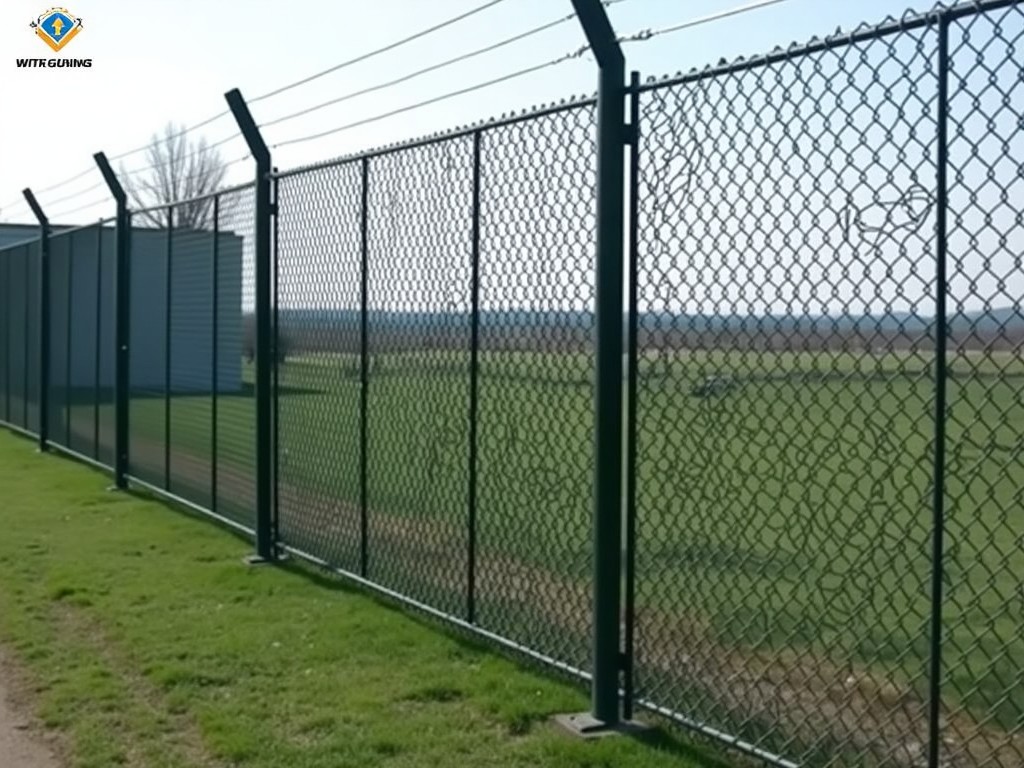
China High Security Prison 358 Mesh Fencing Factory
The 358 mesh fencing system, also known as prison mesh, consists of 3 mm vertical and horizontal wires spaced at 76.2 mm centers, forming a rigid anti‑climb barrier. Manufacturers produce the panels
Request a QuoteChina High Security Prison 358 Mesh Fencing Factory
The 358 mesh fencing system, also known as prison mesh, consists of 3 mm vertical and horizontal wires spaced at 76.2 mm centers, forming a rigid anti‑climb barrier.
Manufacturers produce the panels by welding the wires at each intersection, then applying a protective coating to resist corrosion in outdoor environments.
| Parameter | Typical Value |
|---|---|
| Wire diameter (vertical/horizontal) | 3 mm |
| Mesh opening | 76.2 mm × 76.2 mm |
| Panel height | Customizable, common range 1.8 m – 3.0 m |
| Panel width | Customizable, typical 2.5 m – 3.0 m |
| Coating type | Hot‑dip galvanized (≥55 µm Zn) or PVC‑coated (optional) |
| Tensile strength of wire | ≥450 MPa (cold‑drawn steel) |
Material Composition
The core wire is low‑carbon steel with a carbon content typically below 0.12 %, providing sufficient ductility for welding while maintaining high tensile strength.
After welding, panels undergo hot‑dip galvanization where molten zinc forms a metallurgical bond, delivering a uniform coating thickness that meets ISO 1461 specifications.
For environments with aggressive chemicals or high humidity, a PVC over‑coat can be applied, adding a 0.5 mm polymer layer that improves abrasion resistance.
Structural Design
The 358 pattern creates a small aperture that prevents handholds and footholds, effectively deterring climbing attempts.
Vertical wires are welded to horizontal wires at every intersection, resulting in a grid with a shear resistance that exceeds 15 kN per panel under standard test conditions.
Panel edges are reinforced with a folded flange or a C‑section frame, which increases bending stiffness and facilitates secure attachment to posts.
Applications in Correctional Facilities
Correctional institutions select 358 mesh for perimeter security because the combination of small opening and high rigidity reduces the likelihood of contraband passage and unauthorized scaling.
The fencing can be integrated with detection devices such as vibration sensors or fiber‑optic cables without compromising structural integrity.
Beyond prisons, similar specifications are used in military bases, detention centers, and high‑value storage sites where climb resistance is a priority.
Manufacturing Process
Wire is first drawn to the target diameter, then straightened and cut to length before being fed into an automated welding line.
Spot welding electrodes apply a controlled current, forming a fusion bond at each wire cross‑point; weld penetration is monitored to ensure consistency.
After welding, panels are cleaned, flux‑removed, and immersed in a zinc bath at approximately 450 °C for the hot‑dip galvanizing step.
Finally, panels are inspected, cut to final dimensions, and bundled for shipment.
Quality Assurance
Dimensional checks are performed on each batch using laser‑based measuring systems to verify wire spacing and panel squareness within ±2 mm tolerance.
Coating thickness is measured with a magnetic inductance gauge; panels falling below the specified minimum are re‑processed.
Mechanical tests include tensile sampling of wire and shear testing of welded joints to confirm strength requirements.
Customization Options
Panel height and width can be adjusted to match site‑specific fence layouts, with modular designs allowing rapid on‑site assembly.
Post types include round steel, square tubular, or concrete‑embedded options, each compatible with the panel’s flange system.
Additional features such as barbed wire arms, razor ribbon, or integrated sensor conduits can be supplied as pre‑fabricated attachments.
Packaging and Logistics
Panels are stacked flat, separated by protective cardboard or plastic spacers, then secured with steel straps to prevent movement during transit.
Standard pallet dimensions accommodate 20‑foot containers, allowing up to 30 m² of fencing per pallet depending on panel size.
For overseas shipments, corrosion‑inhibiting vapor bags can be added inside the packaging to maintain coating integrity.
Frequently Asked Questions
- Can dimensions be customized? Yes, height, width, and wire diameter are adjustable per project requirements.
- What information is required before quotation? Required details include desired panel dimensions, coating preference, post type, quantity, and delivery destination.
- What materials are available? Base wire is low‑carbon steel; coatings offered are hot‑dip galvanized, PVC‑coated, or a combination.
- How is quality inspected? Inspection covers dimensional accuracy, coating thickness, weld strength, and visual surface condition.
- What packaging methods are available? Panels are palletized with spacers and straps; optional vapor‑barrier bags for export.
- How are export shipments protected? Pallets are stretch‑wrapped and secured in containers; desiccant packs may be added upon request.
- What is the typical production lead time? Lead time ranges from 2 to 4 weeks after confirmation of specifications, depending on order size.
- How are samples arranged? Sample panels (up to 1 m²) can be shipped via express courier, with costs credited against a subsequent order.
Contact for Inquiry
To request a detailed quotation or technical datasheet, please provide your project specifications.
Send Inquiry


