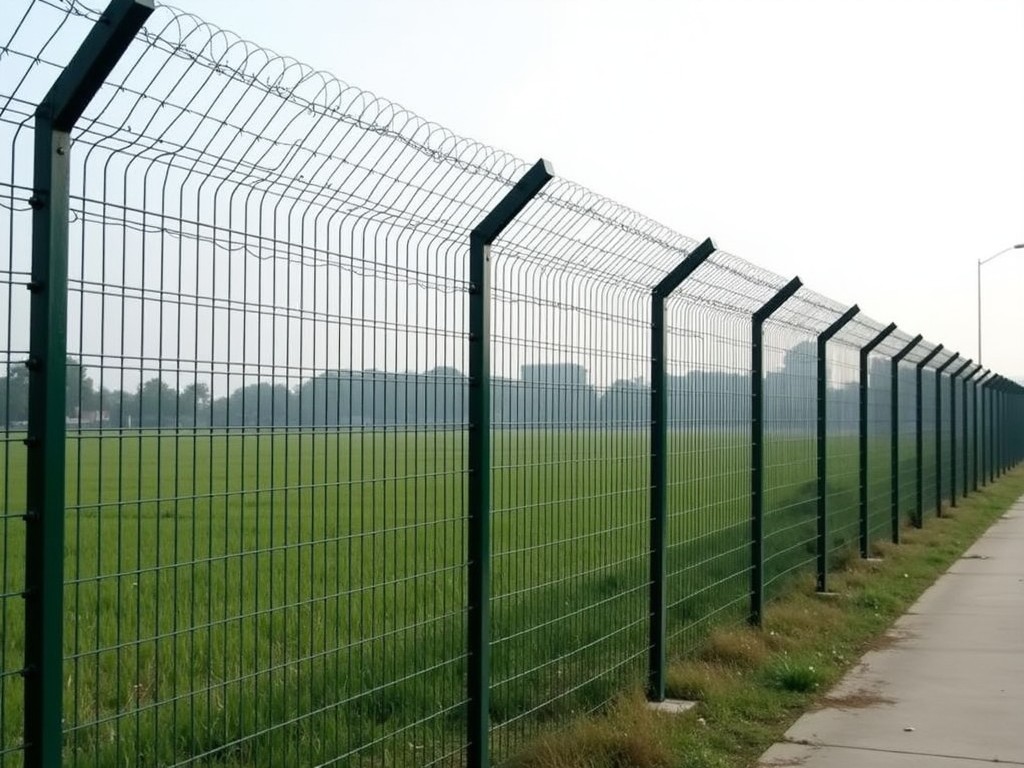
China Double Strand Barbed Wire Fence Manufacturer
A double strand barbed wire fence consists of two parallel steel wires that are helically twisted together, with uniformly spaced barbs formed on each wire. This configuration provides increased
Request a QuoteDouble Strand Barbed Wire Fence
A double strand barbed wire fence consists of two parallel steel wires that are helically twisted together, with uniformly spaced barbs formed on each wire. This configuration provides increased tensile capacity and redundancy compared to a single‑strand design.
The core wires are typically produced from low‑carbon steel rods drawn to diameters ranging from 1.2 mm to 2.5 mm. After drawing, the wires are hot‑dip galvanized (Zn coating ≥55 g/m²) or optionally coated with PVC for additional corrosion protection and color coding.
Manufacturing proceeds by feeding the two wires through a twisting machine that imparts a uniform lay length (typically 45 mm to 70 mm) while simultaneously forming barbs via a cutting‑and‑bending die. Barb length is usually 15 mm to 22 mm, and barb spacing is set between 75 mm and 150 mm depending on the required security level.
Mechanical properties are governed by the wire tensile strength (generally 350 MPa to 550 MPa for galvanized steel) and the helical geometry, which contributes to a break‑load increase of approximately 20‑30 % over a single strand of equivalent diameter. Elongation at break remains above 10 %, allowing the fence to accommodate thermal expansion and impact loads without sudden fracture.
Typical Applications
The dual‑strand layout is chosen where a higher barrier performance is needed without increasing post size or foundation depth. Common uses include perimeter security for industrial facilities, correctional institutions, military installations, and high‑value storage yards.
- Livestock containment where animal pressure can cause single‑wire sagging.
- Temporary construction site fencing requiring rapid deployment and re‑tensioning.
- Agricultural field boundaries exposed to wildlife pressure.
- Infrastructure protection along highways, railways, and pipeline corridors.
Customization Parameters
Buyers can specify the following variables to match site‑specific load, environmental, and regulatory requirements:
- Wire diameter (1.2 mm – 2.5 mm)
- Barb length (12 mm – 25 mm)
- Barb spacing (50 mm – 200 mm)
- Strand lay length (30 mm – 80 mm)
- Coating type (hot‑dip galvanized, Galfan, PVC‑coated, polyester powder)
- Roll length (50 m – 500 m) or custom cut lengths
Quality Control & Testing
Each production lot undergoes a defined inspection regime to verify mechanical and protective attributes:
- Tensile strength test on sampled strands (ASTM A370)
- Coating weight measurement (gravimetric method)
- Barb geometry verification using calipers and visual inspection
- Elongation and bend‑back tests to ensure ductility
- Salt‑spray corrosion resistance (ASTM B117) for coated variants
Specification Table
| Parameter | Typical Range | Notes |
|---|---|---|
| Wire Diameter | 1.2 mm – 2.5 mm | Selected based on required tensile load |
| Barb Length | 12 mm – 25 mm | Longer barbs increase deterrence |
| Barb Spacing | 50 mm – 200 mm | Closer spacing yields higher obstacle density |
| Strand Lay Length | 30 mm – 80 mm | Affects flexibility and twist stiffness |
| Coating | Hot‑dip Zn (≥55 g/m²), Galfan, PVC, Polyester | Choice influences corrosion life and color |
| Tensile Strength (wire) | 350 MPa – 550 MPa | Resultant fence strength ≈ 1.2‑1.3× wire strength |
| Standard Roll Length | 50 m – 500 m | Custom lengths available on request |
Frequently Asked Questions
Can the wire diameter and barb spacing be customized? Yes, both parameters are adjustable to meet specific load or security specifications; please provide the required values when requesting a quote.
What information is needed for an accurate quotation? Required details include wire diameter, barb length, barb spacing, lay length, coating type, roll length, and any applicable standards (e.g., ASTM, EN).
How is the coating adhesion verified? We perform a bend‑test according to ASTM D3359 and measure coating weight via gravimetric stripping to ensure compliance with the specified Zn or polymer thickness.
What packaging methods are used for export shipments? Rolls are wrapped in UV‑stabilized polyethylene film, placed on wooden pallets, and secured with steel straps; corner protectors and moisture‑absorbent packets are added as needed.
To obtain a detailed quotation or discuss technical specifications, please contact our sales team.
Request Quote


