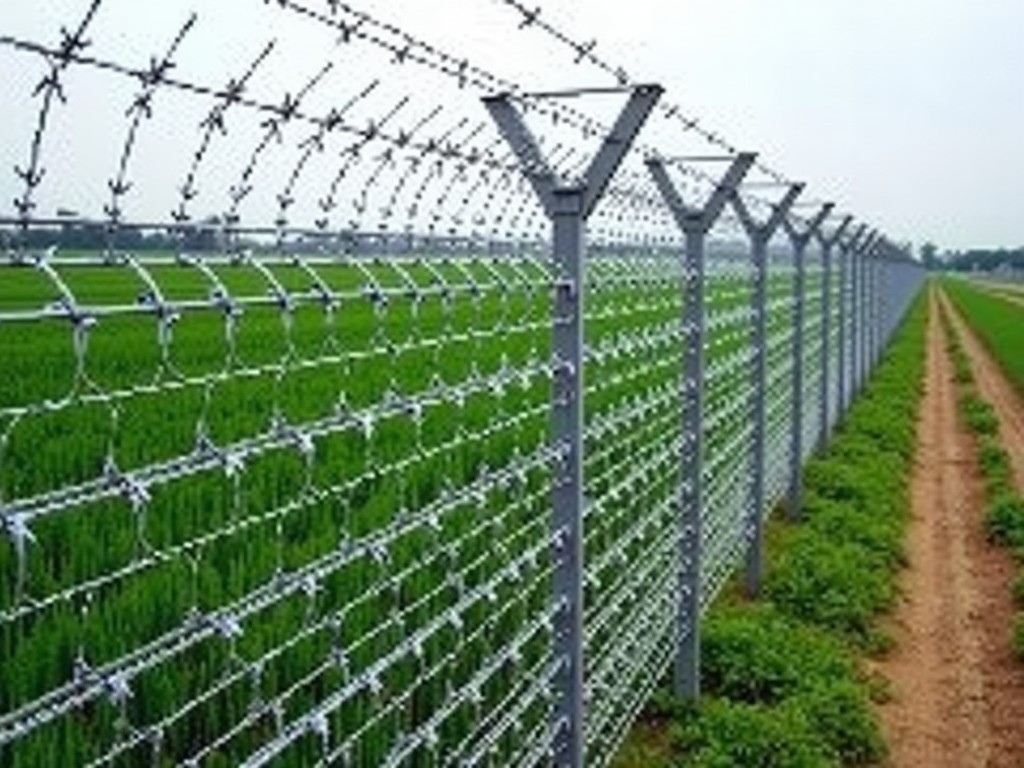
Bulk Razor Barbed Wire Fence Exporter
Razor barbed wire combines high‑tensile steel core with sharp, angular barbs spaced at regular intervals to create a deterrent barrier. The product is supplied in continuous rolls or pre‑cut panels,
Request a QuoteBulk Razor Barbed Wire Fence Exporter
Overview
Razor barbed wire combines high‑tensile steel core with sharp, angular barbs spaced at regular intervals to create a deterrent barrier. The product is supplied in continuous rolls or pre‑cut panels, enabling rapid installation for perimeter security, correctional facilities, military installations, and industrial sites where intrusion resistance is critical.
Technical Specifications
| Parameter | Typical Value | Notes |
|---|---|---|
| Core wire diameter | 2.5 mm – 3.0 mm | Cold‑drawn high‑carbon steel |
| Barb thickness | 0.8 mm – 1.2 mm | Formed from same alloy as core |
| Barb spacing | 50 mm – 150 mm | Adjustable per order |
| Tensile strength | ≥ 1 700 MPa | Measured per ASTM A370 |
| Coating options | Galvanized (Zn ≥ 275 g/m²) or PVC‑coated | Custom thickness on request |
Material Composition
The core wire is manufactured from SAE 1080 high‑carbon steel, providing a balance of ductility and tensile strength. Barbs are punched from the same wire stock, ensuring uniform metallurgical properties. Optional hot‑dip galvanizing applies a zinc layer that meets ISO 1461 for corrosion resistance; PVC coating adds a polymer barrier with a typical thickness of 0.3 mm, available in black, green, or grey.
Manufacturing Process
Wire drawing reduces the rod to the target diameter while maintaining a consistent grain structure. The drawn wire is then fed into a barb‑forming machine where precision dies cut and twist the barbs at the specified pitch. After forming, the product passes through a cleaning line, followed by either a galvanizing bath (temperature ≈ 450 °C) or an extrusion line for PVC coating. Final spooling occurs under controlled tension to prevent deformation.
Applications
Correctional facilities employ razor barbed wire atop perimeter walls to delay escape attempts, relying on the barb geometry to snag clothing and skin. Military bases use it as a low‑cost, rapidly deployable obstacle that complicates vehicle and foot penetration. Industrial sites such as power substations and data centers install it to deter theft and vandalism, where the visible threat reduces attempted breaches.
Quality Assurance
Each batch undergoes tensile testing on a universal testing machine, with results recorded against the ≥ 1 700 MPa threshold. Coating thickness is measured via magnetic induction for galvanization and ultrasonic gauging for PVC. Visual inspection verifies barb uniformity and absence of defects such as cracks or uneven twists. Documentation includes material certificates, test reports, and compliance with ISO 9001:2015.
Customization Options
Customers may specify core diameter, barb length, spacing, and coating type. Lengths are supplied in standard 50 m rolls or cut to exact panel dimensions, with tolerances of ± 5 mm. Custom packaging (e.g., wooden pallets with protective corner boards) can be arranged to meet specific handling requirements.
Packaging and Export
Rolls are wrapped in UV‑stabilized polyethylene film, then placed on steel‑banded pallets secured with stretch wrap. For long‑distance shipments, pallets are fitted with moisture‑absorbent desiccants and corner protectors. Export documentation includes fumigation certificates (if required), bill of lading, and origin declaration. Lead time typically ranges from 15 to 30 working days after receipt of purchase order, depending on coating selection and order volume.
Frequently Asked Questions
- Can the barb spacing be altered for a specific security level?
- What information is needed to obtain a quotation?
- Which coating offers the best lifespan in a marine environment?
- How is the tensile strength verified during production?
- What pallet sizes are used for standard 50 m rolls?
- Are samples available for evaluation before a bulk order?
For technical inquiries, custom specifications, or to request a formal quotation, please use the contact form below.
Send Inquiry


