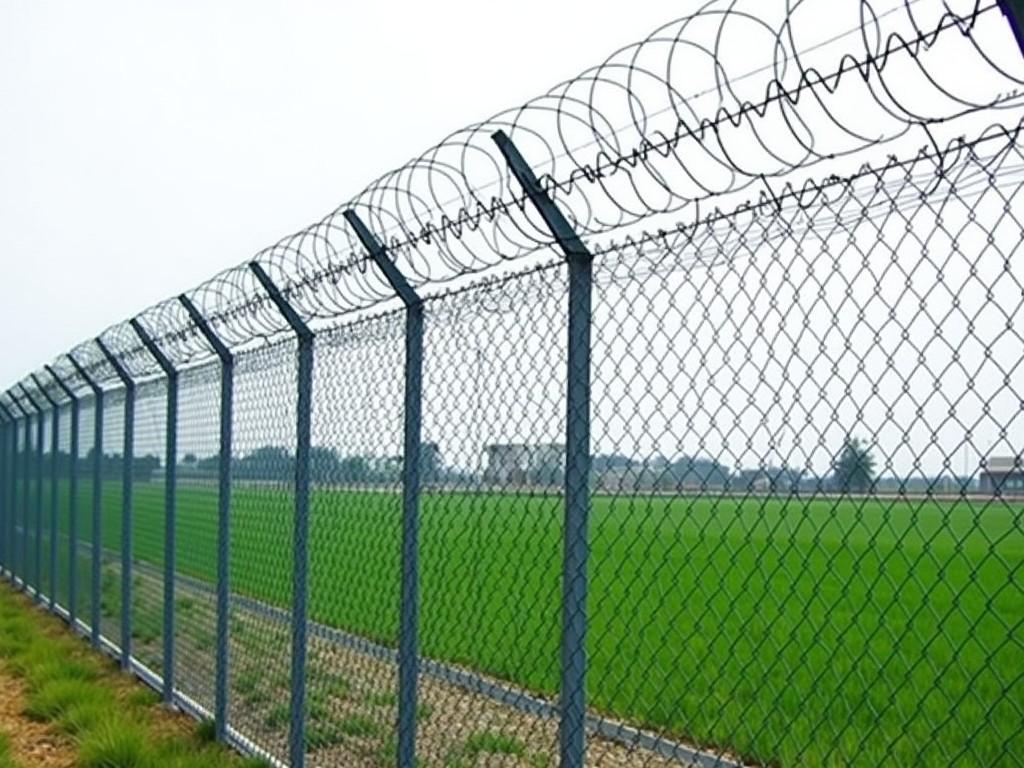
Best Price Gi Concertina Razor Barbed Wire Fence Supplier
Galvanized iron (GI) concertina razor barbed wire combines a high‑tensile steel core with a protective zinc coating and sharp barbs arranged in a concertina coil to provide a high‑security perimeter
Request a QuoteBest Price GI Concertina Razor Barbed Wire Fence Supplier
Galvanized iron (GI) concertina razor barbed wire combines a high‑tensile steel core with a protective zinc coating and sharp barbs arranged in a concertina coil to provide a high‑security perimeter barrier.
Technical Specifications
| Parameter | Typical Value | Customizable Range |
|---|---|---|
| Core wire diameter | 2.5 mm | 2.0 mm – 3.0 mm |
| Barb wire diameter | 3.0 mm | 2.5 mm – 3.5 mm |
| Tensile strength (core) | ≥1550 MPa | 1300–1800 MPa (per grade) |
| Zinc coating (GI) | 275 g/m² (≈20 µm) | 180–350 g/m² |
| Coil outer diameter | 450 mm | 300–600 mm |
| Loop pitch (distance between loops) | 100 mm | 80–150 mm |
| Barb spacing along wire | 75 mm | 50–100 mm |
| Standard roll length | 20 m | 10–50 m |
Material Composition and Corrosion Protection
The core wire is produced from cold‑drawn high‑carbon steel, achieving a tensile strength of at least 1550 MPa after drawing. The barb wire is similarly drawn and then helically wrapped around the core at a defined pitch.
Galvanization is performed via hot‑dip process, forming a zinc‑iron alloy layer that provides sacrificial protection. Coating thickness is measured per ISO 1461; typical 275 g/m² corresponds to approximately 20 µm, giving a service life of 15–20 years in rural atmospheres and 8–12 years in industrial environments.
For aggressive chemical exposure, optional aluminum‑zinc (AZ) or polymer overcoat can be applied, increasing corrosion resistance by 30–50 % according to ASTM B117 salt‑spray testing.
Manufacturing Process
Production begins with wire drawing to the specified diameter, followed by cleaning and pickling to remove oxides. The cleaned wire then passes through a hot‑dip galvanizing bath at approximately 450 °C, ensuring metallurgical bonding of zinc to steel.
After galvanizing, the wire is cut to length and formed into concertina coils on a precision winding machine. The barb wire is simultaneously fed and wrapped around the core, maintaining uniform barb spacing and loop pitch. Final coils are tension‑checked and cut to the required roll length.
Quality control points include diameter measurement (±0.02 mm), coating thickness measurement (X‑ray fluorescence), tensile testing of samples, and visual inspection for barb uniformity.
Quality Assurance and Testing
- Dimensional verification: wire diameter, coil outer diameter, loop pitch, barb spacing.
- Coating mass: gravimetric method per ISO 1460, target 275 g/m² ±10 %.
- Mechanical testing: tensile strength and elongation at break (ASTM A370).
- Corrosion resistance: salt‑spray (ASTM B117) for 500 h, rating ≤5 % red rust.
- Visual inspection: barb sharpness, coil tightness, absence of cracks or splits.
Applications
GI concertina razor barbed wire is selected where a combination of physical deterrent and low maintenance is required. The concertina geometry allows rapid deployment and creates a tangled obstacle that increases the time and effort needed to breach a perimeter.
Typical installations include:
- Military bases and forward operating posts – provides immediate barrier against vehicle and personnel intrusion.
- Correctional facilities – enhances wall security where climbing or cutting tools are a concern.
- Industrial storage yards – deters theft of valuable equipment and materials.
- Border control and customs checkpoints – supplements electronic surveillance with a physical delay mechanism.
- Critical infrastructure (power substations, water treatment plants) – protects against sabotage and unauthorized access.
The wire’s galvanized finish ensures longevity in outdoor environments, reducing lifecycle cost compared to painted or untreated alternatives.
Comparison with Alternative Barrier Products
| Feature | GI Concertina Razor Wire | Standard Barbed Wire | PVC‑Coated Chain Link |
|---|---|---|---|
| Tensile strength (core) | ≥1550 MPa | 800–1000 MPa | 250–350 MPa (steel core) |
| Corrosion protection | Hot‑dip GI, 275 g/m² Zn | GI or PVC, variable | PVC coating over steel |
| Intrusion delay (seconds) | 12–18 (concertina tangle) | 4–6 | 6–9 |
| Installation time (per 100 m) | 30–45 min (coil deployment) | 20–30 min (stapling) | 45–60 min (post setting) |
| Typical service life (rural) | 15–20 years | 8–12 years | 12–18 years |
Frequently Asked Questions
Contact for Inquiry
To obtain a detailed quotation or discuss customization options, please provide your project specifications. Our technical team will respond with a formal proposal, including lead time, pricing, and compliance documentation.
Request Quote


