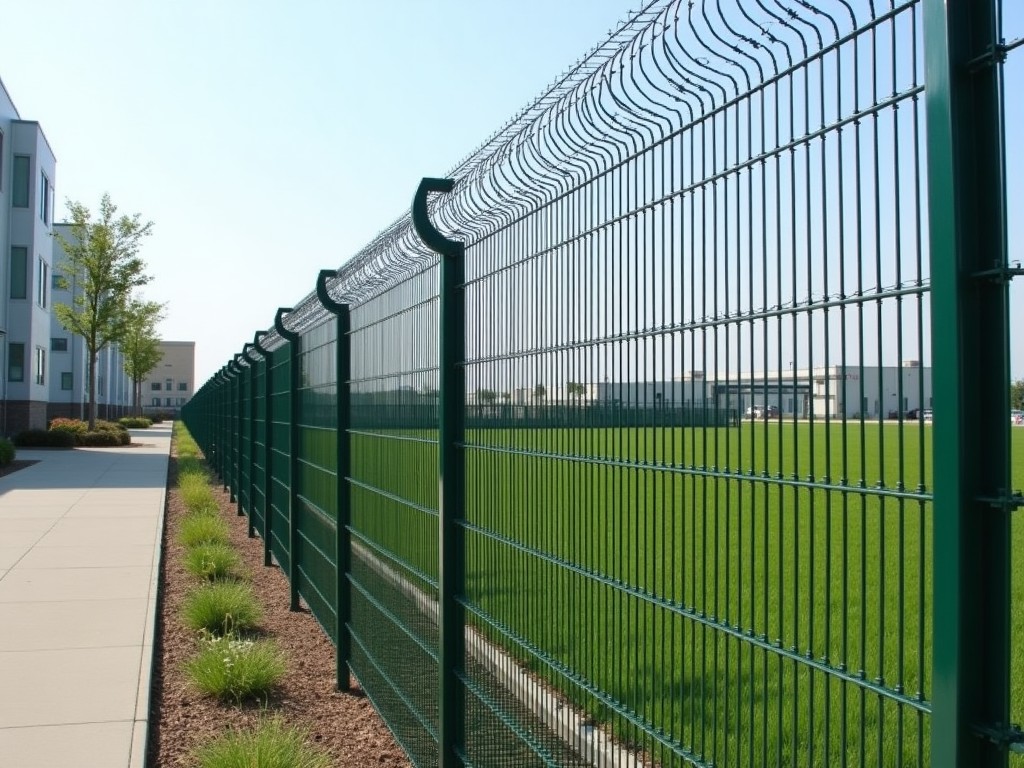
B2B Residential Barbed Wire Fence Supplier
Residential barbed wire fence systems are engineered to provide a physical deterrent while maintaining a low visual profile suitable for housing developments, estate boundaries, and agricultural
Request a QuoteB2B Residential Barbed Wire Fence Supplier
Residential barbed wire fence systems are engineered to provide a physical deterrent while maintaining a low visual profile suitable for housing developments, estate boundaries, and agricultural peripheries. The design balances tensile strength with ease of installation, allowing contractors to deploy continuous runs over uneven terrain without specialized equipment.
Technical Specifications
Standard configurations are defined by wire gauge, barb geometry, and coating thickness, which directly influence load‑bearing capacity and corrosion life. Exact values are adjusted according to local wind loads, soil conditions, and desired service life.
| Parameter | Typical Range | Unit |
|---|---|---|
| Wire Diameter | 2.0 – 2.8 | mm |
| Barb Length | 15 – 25 | mm |
| Barb Spacing | 75 – 150 | mm |
| Roll Length | 50 – 200 | m |
| Tensile Strength (Wire) | 550 – 700 | MPa |
| Coating Thickness (Zn) | 55 – 85 | µm |
Material Options
The core wire is produced from low‑carbon steel billets, selected for consistent elongation and yield strength. Surface treatments are applied to extend service life in varied atmospheric exposures, ranging from rural to marine‑influenced zones.
- Hot‑dip galvanized (Zn) coating per ASTM A123
- Galvanized‑plus‑PVC overlay for color coding and added abrasion resistance
- Stainless‑steel core (Grade 304) for chloride‑rich environments
- Aluminum‑zinc alloy (Galvalume) coating for enhanced UV stability
Design and Construction
Fence assemblies consist of line posts, tension wires, and the barbed strand itself. Posts are typically rolled‑section steel or timber, set in concrete footings to resist lateral loads. The barb formation is executed via high‑speed twisting, ensuring uniform geometry and minimal stress concentrations.
- Post spacing: 2.5 – 3.0 m (adjustable for terrain)
- Number of barb strands: 1‑2 per line, depending on security level
- Tensioning devices: ratchet or lever‑type take‑up to maintain 150‑250 N preload
- Optional bottom tension wire to prevent lift‑off under wind uplift
Applications
Residential installations benefit from the fence’s ability to deter trespassing while requiring minimal groundwork. The low‑height profile (typically 1.0‑1.2 m) preserves sightlines and complies with many municipal zoning restrictions that prohibit solid barriers. Additionally, the open design reduces wind loading, lowering foundation costs compared with closed‑panel systems.
Typical use cases include perimeter security for gated communities, livestock containment on hobby farms, and protection of utility easements where visual transparency is preferred for inspection access.
Quality Assurance
Each production lot undergoes mechanical testing to verify tensile strength and elongation, conforming to ISO 6892‑1. Coating adhesion is assessed via pull‑off tests (ASTM D4541) to ensure the zinc or polymer layer remains intact after bending and impact. Visual inspection checks for barb uniformity, wire surface defects, and correct roll tension before packaging.
- Tensile test sample size: 5 specimens per lot
- Coating thickness measured via X‑ray fluorescence at 10 points per roll
- Impact resistance evaluated with a 2 J pendulum strike on bent specimens
- Final audit includes roll length verification and label legibility
Customization Options
Projects often require adjustments to barb geometry, roll length, or finish color to match site‑specific security levels or aesthetic guidelines. Customization is performed at the slitting and coating stages, allowing precise control over dimensions without compromising material continuity.
- Wire diameter: 1.8 mm to 3.2 mm (in 0.1 mm increments)
- Barb length: 10 mm to 30 mm (customizable)
- Barb spacing: 50 mm to 200 mm (adjustable)
- Roll length: 20 m to 300 m (based on handling equipment)
- Coating color: standard grey, green, brown, or custom RAL upon request
Packaging and Shipping
Finished rolls are wrapped in UV‑stabilized polyethylene film to prevent moisture ingress during transit. Each roll is placed on a wooden pallet with edge protectors and secured with polyester strapping. Palletized loads are stacked no higher than four rolls to avoid deformation of the barb geometry.
- Primary protection: 150 µm co‑extruded PE film
- Secondary protection: corner cardboard guards
- Pallet size: 1.1 m × 1.1 m (standard Euro pallet)
- Loading capacity: up to 24 rolls per full truckload (≈ 18 t)
- Export packaging includes fumigated timber and moisture‑desiccant packets
Frequently Asked Questions
- Can the barb spacing be altered after production? No, barb spacing is set during the twisting operation; any change requires a new production run.
- What information is needed for a quotation? Required details include wire diameter, barb length, barb spacing, roll length, coating type, and delivery destination.
- Are stainless‑steel options available for coastal areas? Yes, Grade 304 or 316 cores can be supplied with appropriate passivation.
- How is coating adhesion verified? Pull‑off testing per ASTM D4541 on representative samples from each batch.
- What is the typical lead time for a standard order? Lead time ranges from 3 to 6 weeks depending on coating complexity and order volume.
- Can samples be provided before a bulk purchase? Small‑length samples (up to 5 m) are available upon request, with shipping costs borne by the requester.
Contact for Inquiry
To discuss project‑specific requirements, request a formal quote, or obtain technical data sheets, please reach out to our engineering team. Providing the application details, desired dimensions, and any environmental constraints will enable us to prepare an accurate and timely response.
Request a Quote


