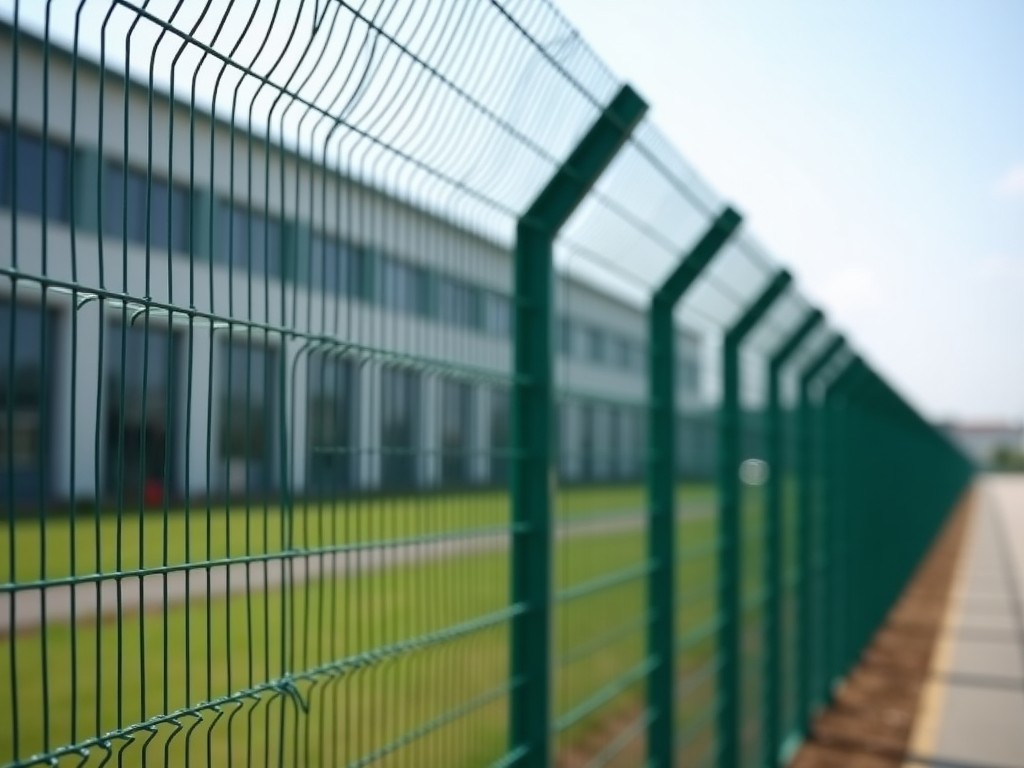
B2B Razor Wire Fence Supplier Factory
Razor wire fences consist of high-tensile steel core wire wrapped with sharp-edged barbs formed from cold-rolled steel tape. The assembly provides a continuous barrier that resists cutting and
Request a QuoteB2B Razor Wire Fence Supplier Factory
Product Overview
Razor wire fences consist of high-tensile steel core wire wrapped with sharp-edged barbs formed from cold-rolled steel tape. The assembly provides a continuous barrier that resists cutting and climbing.
Typical core wire diameter ranges from 2.5 mm to 3.5 mm, while the barb tape thickness is 0.5 mm to 0.8 mm. The combined tensile strength of the core exceeds 1 800 MPa, ensuring minimal sag over long spans.
Technical Specifications
| Parameter | Typical Range | Notes |
|---|---|---|
| Core Wire Diameter | 2.5 mm – 3.5 mm | Cold‑drawn high‑carbon steel |
| Barb Tape Thickness | 0.5 mm – 0.8 mm | Galvanized or stainless steel |
| Barb Spacing | 75 mm – 150 mm | Center‑to‑center distance |
| Coating | Hot‑dip galvanized (Zn ≥ 275 g/m²) or PVC‑coated | Customizable per environment |
| Roll Length | 10 m – 50 m per roll | Standard packaging; custom lengths on request |
Material Options and Corrosion Resistance
The core wire is manufactured from high‑carbon steel (C ≈ 0.8 %). After drawing, it receives a hot‑dip zinc coating that meets ISO 1461 for corrosion protection. In aggressive environments (coastal, industrial), a PVC over‑coat or stainless‑steel core (grade 304 or 316) can be specified.
Barb tape is slit from cold‑rolled steel strip, then galvanized. The sharp edges are formed by a precision‑roll forming process that maintains a consistent blade angle of approximately 45°, ensuring uniform penetration resistance.
Applications in Industrial Security
Razor wire is deployed where a high‑deterrent barrier is required without the visual bulk of concrete walls. Typical installations include perimeter fencing around substations, storage terminals, and correctional facilities.
The wire’s low‑profile geometry allows integration with existing chain‑link or welded mesh fences, adding a security layer that increases climb time by an estimated 30‑50 % compared to plain mesh alone.
- Perimeter protection for power generation sites
- Secure enclosure for hazardous material warehouses
- Temporary barrier for construction zones
- Border control and detention facility perimeters
Customization Logic
Customization follows a risk‑based approach: the client provides site‑specific data such as expected attack tools, environmental corrosion class, and required barrier height. Based on these inputs, we select core diameter, barb spacing, and coating type.
For example, a facility expecting bolt‑cutter attempts may receive a 3.5 mm core with 75 mm barb spacing, while a low‑risk site may use a 2.5 mm core with 150 mm spacing to reduce material cost.
Quality Control Philosophy
Each production lot undergoes dimensional verification using laser micrometers (±0.02 mm accuracy) and tensile testing per ASTM A370. Coating thickness is measured with magnetic‑induction gauges to confirm compliance with the specified zinc mass.
Visual inspection of barb sharpness is performed under 10× magnification; any blade with a radius greater than 0.2 mm is rejected. Finished rolls are subjected to a 100 h salt‑spray test (ASTM B117) for coated samples, with acceptance criteria of less than 5 % red rust.
Packaging and Shipping
Rolls are wrapped in UV‑stabilized polyethylene film, then placed on wooden pallets with corner protectors. Each pallet is secured with steel straps and labeled with product code, length, and coating type.
For export, pallets are fitted with heat‑shrink wrap and placed inside ISO‑standard containers. Desiccant packets are included to control moisture during transit.
Frequently Asked Questions
Yes. Core diameter, barb spacing, and roll length are adjusted per project specifications after reviewing site requirements.
We need the intended barrier height, exposure environment (e.g., ISO 12944 corrosion class), expected threat level, and any length constraints.
Standard: high‑carbon steel core with hot‑dip zinc coating. Options: PVC over‑coat, stainless‑steel core (304/316), or galvanized barb tape with alternative coatings.
Dimensional checks, tensile testing, coating thickness measurement, barb sharpness visual inspection, and salt‑spray testing per applicable standards.
Polyethylene film wrap, palletized with corner protectors, steel strapping, and optional heat‑shrink wrap for export.
Lead time ranges from 2 to 4 weeks depending on coating complexity and order volume; exact schedule is confirmed at order acceptance.
Request a Quote
To receive a detailed quotation, please share your project specifications via the contact form. Our engineering team will review the inputs and return a technical proposal within one business day.
Contact Us


