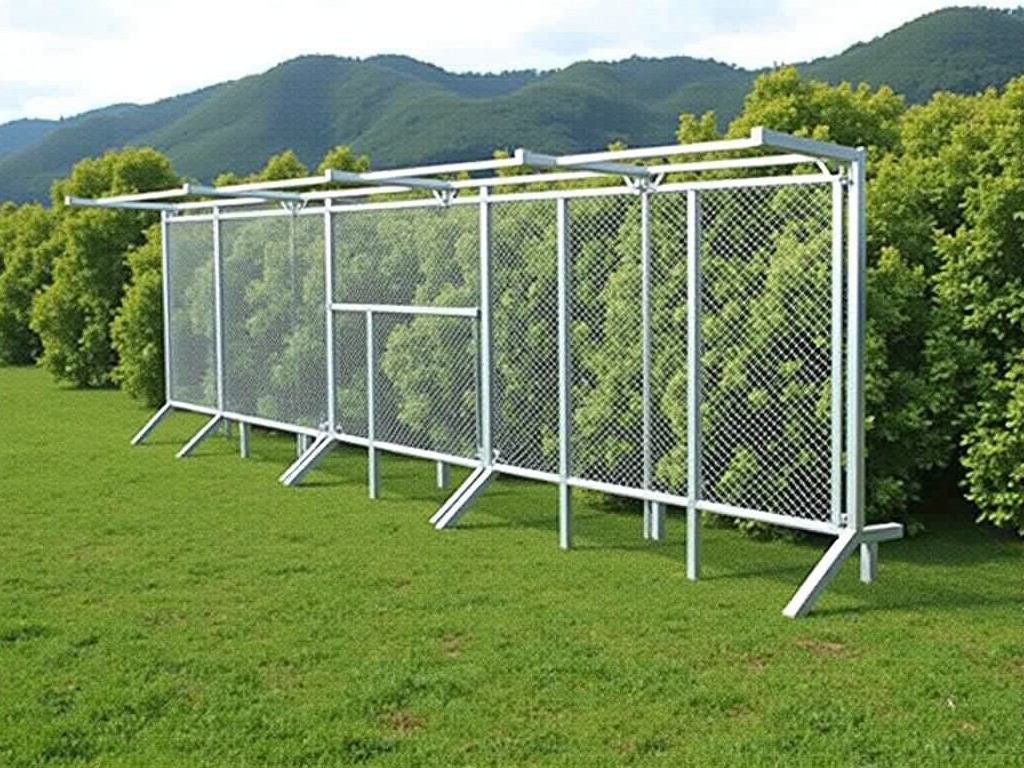
Wholesale Portable Windbreak Panels For Cattle
Portable windbreak panels are engineered structures placed in pasture or feedlot areas to reduce wind speed at animal height, thereby lowering wind chill and improving thermal comfort for cattle. By
Request a QuoteWholesale Portable Windbreak Panels for Cattle
Portable windbreak panels are engineered structures placed in pasture or feedlot areas to reduce wind speed at animal height, thereby lowering wind chill and improving thermal comfort for cattle. By mitigating convective heat loss, these panels can contribute to better feed conversion rates and reduced stress during cold weather periods.
Design and Material Composition
Typical panels consist of a hot‑dip galvanized steel frame that provides structural rigidity and corrosion resistance, combined with a high‑density polyethylene (HDPE) fabric or PVC‑coated polyester mesh that acts as the wind‑blocking surface. The frame members are usually formed from rectangular tubing with a wall thickness of 2.0 mm to 2.5 mm, selected to resist bending under design wind loads while keeping the panel lightweight for manual handling.
Key Technical Characteristics
| Parameter | Typical Value | Unit | Notes |
|---|---|---|---|
| Overall Width (customizable) | 1.2 – 3.0 | m | Width selected based on site layout |
| Overall Height (customizable) | 1.5 – 2.4 | m | Height chosen to match cattle shoulder level |
| Frame Material | Hot‑dip galvanized steel | – | Provides corrosion protection in outdoor environments |
| Frame Wall Thickness | 2.0 – 2.5 | mm | Selected for required moment of inertia |
| Fabric Type | HDPE mesh or PVC‑coated polyester | – | UV‑stabilized for long‑term outdoor exposure |
| Fabric Weight | 200 – 350 | g/m² | Affects wind permeability and durability |
| UV Stabilization | ≥ 1500 hrs | h (QUV) | Typical accelerated weathering test |
| Design Wind Load Capacity | 150 – 250 | Pa (≈ 15–25 kg/m²) | Based on ASCE 7‑16 exposure C; panels tested to resist gusts |
| Weight per Panel (average) | 12 – 20 | kg | Depends on size and fabric choice |
| Connection System | U‑bolt clamps with ground spikes or base plates | – | Allows rapid assembly and disassembly |
Customization Options
- Panel width can be specified in 0.1 m increments from 1.2 m to 3.0 m to match lane or pen dimensions.
- Height options range from 1.5 m for calf areas to 2.4 m for mature cow pens, adjustable in 0.1 m steps.
- Frame finish choices include standard hot‑dip galvanization, powder‑coated colors (e.g., white, green) for aesthetic or corrosion‑enhanced requirements.
- Fabric color selections are available (black, green, white) to suit farm branding or to reduce solar heat gain.
- Reinforced edge options such as double‑stitched hem or PVC piping increase tear resistance at high‑stress points.
- Ground anchoring systems can be chosen as driven steel spikes, concrete‑set base plates, or weighted sandbags depending on soil conditions.
Applications in Cattle Operations
Windbreak panels are installed perpendicular to prevailing wind directions to create sheltered zones where cattle can rest, feed, and drink with reduced convective heat loss. Studies indicate that reducing wind speed from 5 m/s to 2 m/s at animal height can lower the effective temperature by approximately 3–5 °C, which translates into improved weight gain and decreased maintenance energy requirements during winter months.
In addition to thermal benefits, the panels act as a physical barrier that reduces feed and bedding loss caused by wind drift, thereby decreasing waste and improving feed hygiene. The portable nature allows producers to reposition the structures as pasture rotation or pen reconfiguration demands change, providing a flexible management tool.
Quality Control and Testing
Manufacturing follows a documented process where each frame component is inspected for coating thickness, weld continuity, and dimensional tolerances before assembly. Fabric rolls are tested for tensile strength, elongation at break, and UV stability according to ISO 9073‑2 and ASTM D4355 standards. Finished panels undergo a functional wind‑load test in a controlled tunnel to verify that deflection remains within allowable limits under the specified design pressure.
Packaging and Shipping
Panels are typically stacked flat on pallets with protective corner guards and stretch‑film wrapping to prevent abrasion during transit. Each pallet is labeled with part number, dimensions, and weight, and includes a packing list that details any custom features such as special fabric color or anchoring hardware. For export shipments, panels are placed in ISPM‑15 compliant wooden crates or steel frames to meet international phytosanitary requirements.
Frequently Asked Questions
Can the dimensions be customized to fit existing pen layouts?
Yes. Width and height are adjustable in 0.1 m increments, and the frame can be cut to length on‑site if required. Custom lengths beyond the standard range are available upon request after engineering review.
What information is needed to obtain a quotation?
To generate a quote we require the desired panel dimensions (width × height), quantity, preferred frame finish, fabric type and color, and any special anchoring or reinforcement needs. Providing the site’s wind exposure category helps confirm the appropriate design load.
Which materials are available for the frame and fabric?
Frames are offered in hot‑dip galvanized steel as standard, with optional powder‑coating. Fabrics include UV‑stabilized HDPE mesh (200‑350 g/m²) or PVC‑coated polyester (300‑500 g/m²) in various colors.
How is product quality inspected before shipment?
Each panel undergoes a visual inspection for coating defects, a dimensional check of width, height, and squareness, and a functional test where a uniform pressure is applied to verify frame stiffness and fabric integrity.
What packaging methods are available for domestic and export orders?
Domestic orders are shipped on pallets with stretch‑film and corner protection. Export orders are placed in ISPM‑15 compliant wooden crates or steel frames, with additional corner bracing and moisture‑barrier liners as needed.
Contact for Quotation
For detailed pricing, lead times, or to discuss specific site requirements, please reach out to our sales team.
Request a Quote


