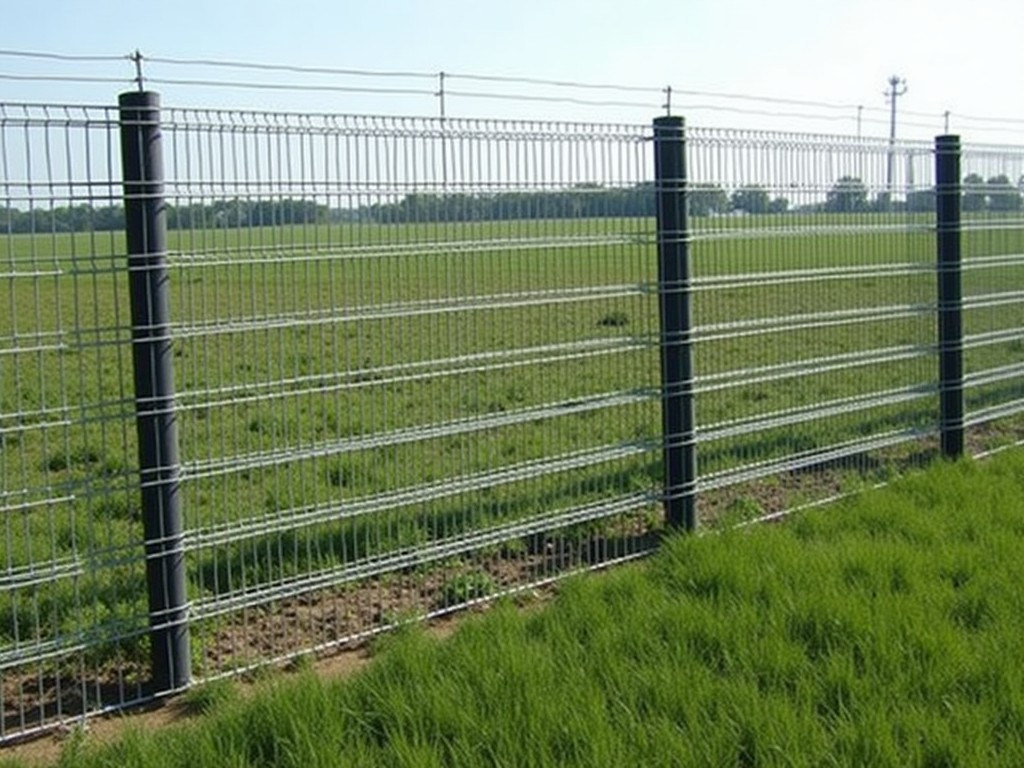
Wholesale High Tensile Cattle Livestock Fence Factory
High tensile livestock fencing provides a barrier that combines strength with flexibility to withstand animal impact and environmental loads. The design resists deformation under pressure from cattle
Request a QuoteWholesale High Tensile Cattle Livestock Fence Factory
High tensile livestock fencing provides a barrier that combines strength with flexibility to withstand animal impact and environmental loads. The design resists deformation under pressure from cattle while maintaining elasticity to absorb shocks. This balance reduces the need for frequent repairs and extends service life in pasture settings.
Material Composition
The steel wire used in this fence originates from low‑carbon steel with a carbon content typically ranging from 0.06% to 0.10%. This composition enables high drawability during wire production while retaining sufficient tensile capacity. A zinc coating of 200 g/m² is applied via hot‑dip galvanization to protect against corrosion in outdoor environments.
Manufacturing Process
Production begins with wire drawing to achieve the required diameter, followed by stranding where individual wires are twisted together to form the fence mesh. The strands are then passed through a galvanizing bath to ensure uniform coating adhesion. Final steps include tensioning, cutting to length, and rolling for shipment.
Mechanical Properties
Typical mechanical values for the fence wire are shown below:
| Property | Typical Value | Test Standard |
|---|---|---|
| Tensile Strength | ≥ 1 700 MPa | ASTM A370 |
| Yield Strength (0.2% offset) | ≥ 1 300 MPa | ASTM A370 |
| Elongation at Break | ≥ 8% | ASTM A370 |
| Wire Diameter (nominal) | 2.0 mm – 3.2 mm | ISO 6932‑1 |
| Zinc Coating Weight | 200 g/m² (both sides) | ASTM A123 |
Design Configurations
Several configuration options are available to suit different site conditions:
- Fixed‑knot mesh for high‑tension applications.
- Hinge‑joint mesh allowing easier installation over uneven terrain.
- Vertical stay spacing options of 150 mm, 200 mm, or 250 mm.
- Horizontal line wire counts ranging from 6 to 12 strands.
- Edge reinforcement with heavier gauge wire for gate openings.
Applications
In cattle operations, the fence serves two primary functions: containment of livestock within designated paddocks and exclusion of predators or stray animals. The high tensile rating allows the fence to withstand impact from running cattle without permanent deformation, while the elastic recovery reduces sag over time. These characteristics lower maintenance intervals and support rotational grazing systems.
Quality Assurance
Quality verification follows a multi‑stage protocol: incoming steel is inspected for chemical composition and surface defects; each production lot undergoes tensile testing on sampled wire; coating thickness is measured with magnetic‑induction gauges; visual inspection checks for uniform twist and absence of broken strands. Finished rolls are labeled with traceability codes linking to test records.
Customization
Dimensions and accessories can be adjusted to match project specifications: roll length, line wire diameter, stay spacing, and post‑attachment hardware are all configurable. Clients requiring non‑standard heights or special gate frames can submit drawings for engineering review. To discuss specific needs, use the contact link below.
Frequently Asked Questions
Common questions from buyers are addressed below:
- Can dimensions be customized?
- Yes, roll length, wire diameter, and mesh geometry can be tailored to project requirements.
- What information is required before quotation?
- Desired fence height, total length, post spacing, and any special accessories such as gate kits or tensioners.
- What materials are available?
- Low‑carbon steel with hot‑dip zinc coating; alternative coatings such as Zn‑Al‑Mg are offered upon request.
- How is quality inspected?
- Each lot undergoes tensile testing, coating weight measurement, and visual inspection as described in the quality assurance section.
- What packaging methods are available?
- Standard packaging includes water‑proof shrink wrap and palletizing; custom crating or container loading can be arranged.
Contact for Inquiry
To discuss your requirements or obtain a sample, contact our sales team:



