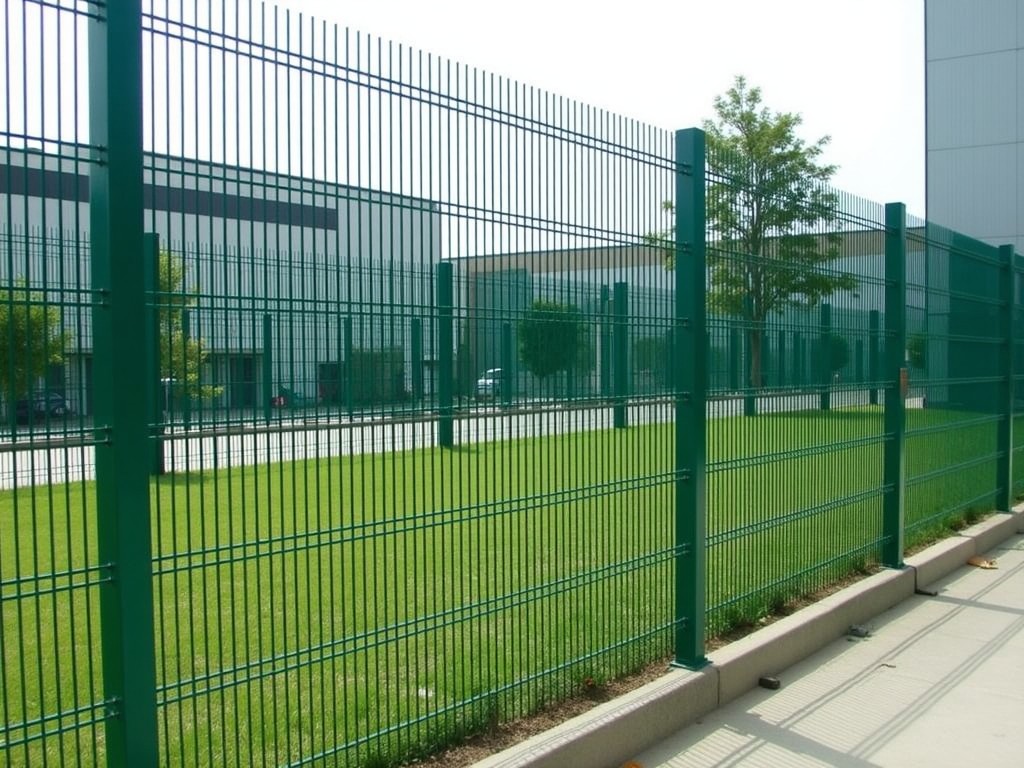
Wholesale Coated Metal Mesh Fence Exporter
A coated metal mesh fence consists of steel wire woven or welded into a grid, then covered with a protective polymer layer. The coating shields the steel from corrosion, extends service life, and
Request a QuoteWholesale Coated Metal Mesh Fence Exporter
A coated metal mesh fence consists of steel wire woven or welded into a grid, then covered with a protective polymer layer. The coating shields the steel from corrosion, extends service life, and provides a uniform appearance suitable for visible installations. Typical base wire diameters range from 1.2 mm to 4.0 mm, while mesh openings vary from 12 mm × 12 mm to 100 mm × 100 mm depending on the required strength and visibility.
Material & Coating Specifications
The core wire is usually low‑carbon steel grades such as Q195 or Q235, offering a tensile strength of 350 MPa to 550 MPa. After forming, the mesh receives a coating of polyvinyl chloride (PVC), polyethylene (PE), or thermoset powder. Coating thickness is controlled between 0.4 mm and 0.8 mm for extruded layers, with adhesion measured by cross‑cut test meeting ISO 2409 Grade 1. UV‑stabilized additives are incorporated to limit color fading to less than 5 ΔE after 1000 h of accelerated weathering.
| Parameter | Typical Range | Notes |
|---|---|---|
| Wire diameter | 1.2 mm – 4.0 mm | Custom diameters available |
| Mesh aperture | 12 mm × 12 mm – 100 mm × 100 mm | Square or rectangular |
| Coating type | PVC, PE, Powder | Customer‑specified |
| Coating thickness | 0.4 mm – 0.8 mm | Measured per ISO 2808 |
Manufacturing Process
Production begins with drawing high‑carbon steel rod to the target wire diameter, followed by annealing to achieve the desired ductility. Wires are then woven on a loom or welded at intersections to form the mesh panel. The fabricated mesh passes through a cleaning line to remove oxides before entering the coating station. For PVC or PE, the mesh is pre‑heated and dipped in molten polymer, then cooled in a water bath to set the thickness. Powder coating applies electrostatically charged particles that are cured at 180 °C–200 °C. Final inspection verifies dimensional stability and coating uniformity before coiling.
Performance Characteristics
Salt‑spray testing per ASTM B117 shows no red rust after 1500 h for a 0.6 mm PVC coating on Q235 wire, indicating suitability for coastal environments. Impact resistance, measured by a falling‑weight test, exceeds 20 J without coating cracking for 2.0 mm wire. The mesh sustains wind loads up to 150 Pa when installed with proper tensioning posts, making it appropriate for perimeter security and agricultural enclosures. Operating temperature range spans –30 °C to +80 °C without loss of flexibility or adhesion.
| Test | Result | Standard |
|---|---|---|
| Salt spray (hours to red rust) | ≥1500 | ASTM B117 |
| Impact resistance (J) | ≥20 | ISO 12443‑2 |
| Wind load capacity (Pa) | ≥150 | EN 1991‑1‑4 |
| Temperature range (°C) | –30 to +80 | Manufacturer data |
Customization Options
- Wire diameter: 1.2 mm to 4.0 mm (steps of 0.2 mm)
- Mesh aperture: square or rectangular from 12 mm to 100 mm
- Roll width: 0.5 m to 3.0 m
- Roll length: 10 m to 100 m (custom lengths on request)
- Coating type: PVC, PE, powder coat
- Coating color: RAL palette or custom match
- Edge finish: knuckle, twisted, or barbed
- Post attachments: welded loops, clamp brackets, or U‑channels
Typical Applications
In agricultural settings, the fence provides livestock containment while allowing visibility and airflow, reducing wind load on the structure. Industrial facilities use coated mesh as a perimeter barrier that deters intrusion without obstructing surveillance camera views. Sports complexes install it around fields to contain balls and protect spectators, benefiting from the coating’s UV stability which prevents degradation under prolonged sun exposure. Construction sites adopt the product for temporary safety enclosures because the coating resists abrasion from debris and can be removed without leaving rust stains on surrounding surfaces.
Quality Control & Testing
Each production lot undergoes incoming wire inspection for diameter tolerance (±0.05 mm) and tensile strength. During weaving/welding, line cameras monitor mesh alignment to maintain aperture uniformity within ±2 mm. After coating, thickness is measured at five points per square meter using a magnetic gauge, with acceptance limited to ±0.05 mm of target. Adhesion is verified by cross‑cut and tape tests per ISO 2409, requiring no coating removal. Final visual inspection checks for bubbles, pinholes, or color variation under standardized lighting (D65, 500 lux). All test results are recorded and available to customers upon request.
Packaging & Export Logistics
Mesh rolls are wrapped in polyethylene shrink film to guard against moisture and abrasion during handling. Rolls are then placed on pallets with corner protectors and secured with polyester strapping. For container shipments, pallets are stacked to maximize cube utilization while maintaining a static load limit of 2000 kg per pallet. Each pallet receives a label indicating product code, dimensions, coating type, and quantity. Export documentation includes material safety data sheets (MSDS) for the coating and certification of compliance with REACH where applicable. Transit times vary by destination, but standard lead time from order confirmation to port readiness is 18‑22 working days.
Frequently Asked Questions
Can dimensions be customized?
Yes, wire diameter, mesh aperture, roll width, and length are all adjustable to meet project specifications. Customers provide the required parameters, and the production team confirms feasibility before quoting.
What information is required before quotation?
To generate an accurate quote we need the desired wire diameter, mesh opening size, roll width, roll length, coating type and color, any special edge finish, and the delivery destination. Quantities above 5000 m² may attract volume pricing.
How is quality inspected?
Quality control includes dimensional checks, coating thickness measurement, adhesion testing, and visual inspection as described in the Quality Control section. Test certificates can be supplied with each shipment.
What packaging methods are available?
Standard packaging uses polyethylene shrink film on pallets. For extra protection, waterproof barrier bags or wooden crates can be arranged at additional cost.
How are export shipments protected?
Shrink‑wrapped rolls are stacked on pallets with corner guards and strapped. Desiccant packs are placed inside the wrapping to control humidity, and the container interior is lined with moisture‑absorbent material for long sea voyages.
What is the typical production lead time?
Lead time depends on order size and coating complexity but generally ranges from 18 to 22 working days for standard specifications after receipt of deposit and confirmed technical datasheet.
How are samples arranged?
Sample sections measuring 1 m × 1 m can be produced within 5 working days. Shipping costs are borne by the requester, and the sample cost is credited against a subsequent order.
Request a Quote
To discuss your project requirements and receive a detailed quotation, please contact our sales team. Provide the specifications outlined above, and we will respond with pricing, lead time, and shipping options within one business day.
Send Inquiry


