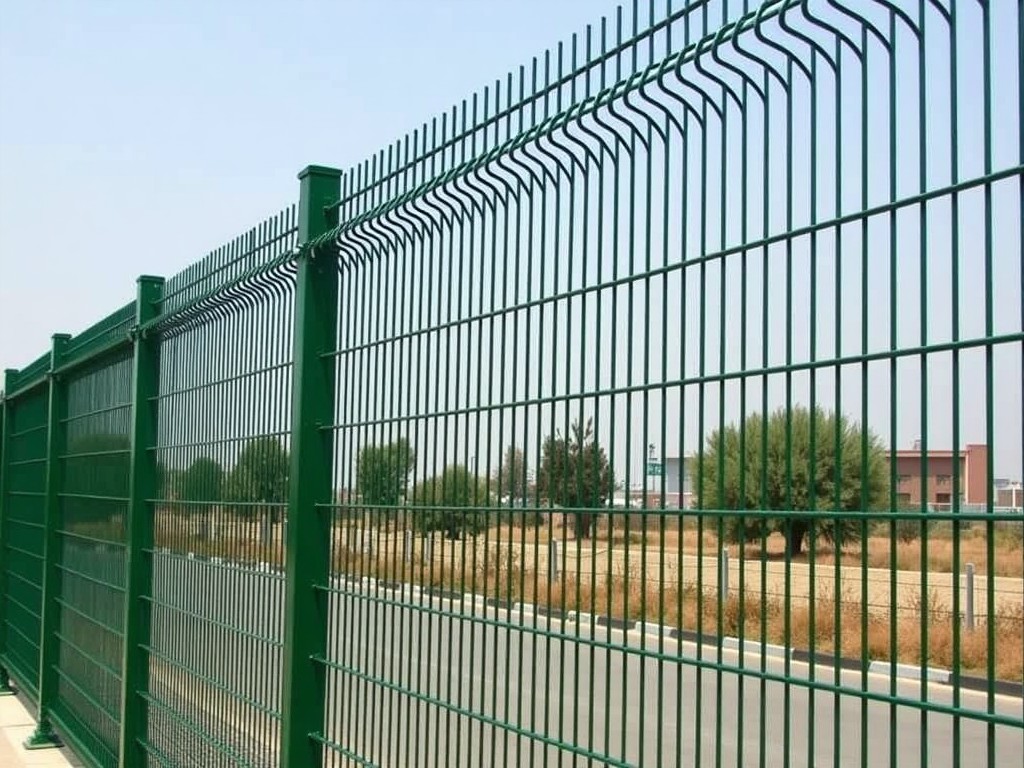
Low Price Cheap Metal Mesh Fencing Supplier
Metal mesh fencing consists of woven or welded steel wires forming a uniform grid pattern. The wire diameter typically ranges from 1.2 mm to 3.0 mm, with mesh openings from 12 mm × 12 mm to 50 mm ×
Request a QuoteLow Price Cheap Metal Mesh Fencing Supplier
Product Overview
Metal mesh fencing consists of woven or welded steel wires forming a uniform grid pattern. The wire diameter typically ranges from 1.2 mm to 3.0 mm, with mesh openings from 12 mm × 12 mm to 50 mm × 50 mm depending on the intended barrier function. Standard roll widths are 0.9 m, 1.2 m, and 1.5 m, while heights can be customized from 0.6 m up to 3.0 m.
Material Options and Coatings
The base wire is usually low‑carbon steel (grade Q195 or equivalent) selected for its tensile strength and weldability. To resist corrosion, manufacturers apply hot‑dip galvanization (Zn coating weight 60‑120 g/m²) or a combination of galvanization followed by PVC powder coating (thickness 80‑150 µm). For aggressive environments, stainless steel wire (grade 304 or 316) can be specified, offering inherent resistance to chlorides and UV exposure.
Typical Specifications
| Parameter | Typical Value | Customizable Options |
|---|---|---|
| Wire Diameter | 1.2 mm – 3.0 mm | Custom diameters per project load requirements |
| Mesh Opening | 12 mm × 12 mm – 50 mm × 50 mm | Special patterns (e.g., rectangular, hexagonal) available |
| Roll Width | 0.9 m, 1.2 m, 1.5 m | Non‑standard widths up to 2.5 m on request |
| Height | 0.6 m – 3.0 m | Custom heights; spliced rolls for taller barriers |
| Tensile Strength (wire) | 350 MPa – 550 MPa | Higher grades for security‑critical installations |
| Coating Type | Hot‑dip galvanized (Zn 60‑120 g/m²) | PVC over‑coat, powder coat, stainless steel |
Applications and Functional Benefits
In perimeter security, the mesh provides a climb‑resistant barrier while maintaining visibility for surveillance cameras. The open area ratio (typically 40‑60 %) allows wind to pass through, reducing lateral load on posts compared with solid panels. For animal containment, the small mesh openings prevent hoof or snout penetration, and the smooth wire surface minimizes injury risk.
Construction sites use the fencing as a temporary safety barrier; its lightweight nature (approximately 2.5 kg/m² for 2 mm wire, 12 mm mesh) enables rapid deployment and relocation. When coated with UV‑stabilized PVC, the product retains color and flexibility for up to five years in outdoor exposure, lowering lifecycle maintenance costs.
Customization and Ordering Process
Customers specify wire diameter, mesh geometry, roll length, and coating type during the quotation phase. Roll lengths are commonly supplied in 25 m or 50 m lengths, but custom lengths up to 100 m can be produced to reduce field splices. Packaging options include waterproof shrink‑wrap on wooden pallets or corrugated cardboard rolls, selected based on transport distance and handling equipment.
Lead time depends on coating selection; standard galvanized rolls ship within 10‑15 working days, while PVC‑coated or stainless variants require 18‑22 working days. Export shipments are secured with corner protectors and stretch film to prevent deformation during transit.
Quality Control and Testing
Each production lot undergoes visual inspection for wire uniformity and weld integrity, followed by dimensional verification of mesh opening and roll width using calibrated gauges. Tensile strength is tested on a sample length according to ISO 6892‑1, with results recorded against the specified grade. Coating thickness is measured by magnetic induction (for Zn) or ultrasonic methods (for PVC) to confirm compliance with the agreed micron range.
Non‑conforming material is segregated and re‑processed; a final audit verifies that the packaged rolls match the order specification before release. Documentation, including test certificates and coating reports, is provided upon request.
Frequently Asked Questions
Can dimensions be customized?
Yes. Wire diameter, mesh opening, roll width, height, and length can be tailored to project requirements. Custom tooling may be needed for non‑standard mesh patterns, which can affect lead time.
What information is required before quotation?
To generate an accurate quote, we need the desired wire diameter, mesh size, roll dimensions, coating type, quantity, and delivery destination. Any special packaging or certification requests should also be specified at this stage.
What materials are available?
Standard options include low‑carbon steel with hot‑dip galvanization, PVC‑over‑coated galvanized steel, and stainless steel grades 304 or 316. Alternative coatings such as powder coat or aluminum‑zinc alloy are available upon request.
How is quality inspected?
Quality control includes visual and dimensional checks, tensile testing of wire samples, and coating thickness measurement. Test reports are supplied with each shipment or can be provided separately.
Contact for Quote
To discuss your specific fencing requirements, request a detailed quotation, or obtain sample material, please use the inquiry form below. Providing the wire diameter, mesh size, roll dimensions, coating preference, and quantity will enable our technical team to prepare an accurate response.



