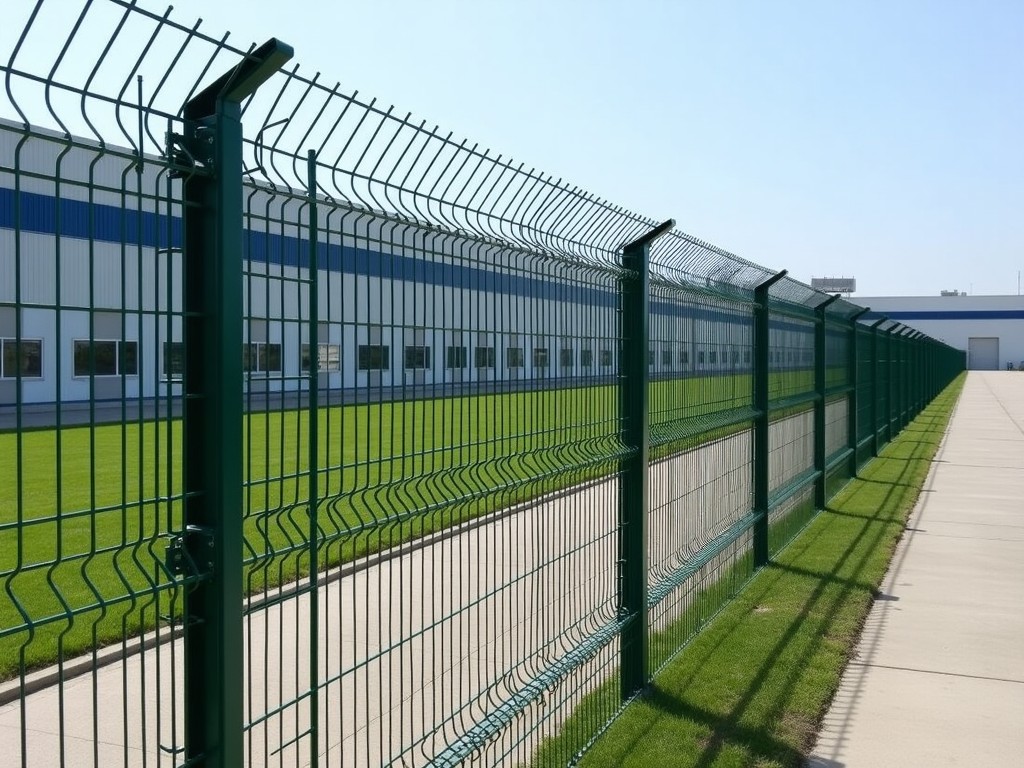
Factory Direct Metal Perimeter Security Fencing
This fencing system consists of roll‑formed steel panels secured to structural posts, creating a continuous barrier that deters unauthorized entry while maintaining visibility for surveillance. The
Request a QuoteFactory Direct Metal Perimeter Security Fencing
This fencing system consists of roll‑formed steel panels secured to structural posts, creating a continuous barrier that deters unauthorized entry while maintaining visibility for surveillance. The panels are fabricated from hot‑dipped galvanized steel, optionally coated with a polymer layer for enhanced corrosion resistance in aggressive environments.
Material selection directly affects service life and maintenance frequency. The base steel meets ASTM A653 SS Grade 50 (minimum yield strength 340 MPa). Hot‑dip galvanizing provides a zinc coating weight of Z275 (275 g/m² total on both sides). For coastal or industrial atmospheres, a polyester powder‑coat over the zinc layer adds a barrier thickness of 80 µm, reducing chloride penetration rates.
Structural design addresses wind loading and impact resistance. Panels are typically 2.4 m wide with vertical ribs spaced 150 mm apart, increasing bending stiffness. Posts are C‑channel sections 100 mm × 50 mm × 3 mm, set in concrete footings at 3 m centers. The system sustains a basic wind speed of 45 m/s (100 mph) without permanent deformation, calculated per ASCE 7‑16 exposure C.
Manufacturing begins with coil slitting to the required width, followed by roll forming to create the panel profile. Continuous welding joins the ribs to the backer plate, and each weld undergoes non‑destructive ultrasonic inspection. After forming, panels pass through a hot‑dip galvanizing line, then a curing oven for powder coat when specified. Final inspection includes dimensional verification (±2 mm on height, ±3 mm on width) and coating adhesion testing (ASTM D4541, minimum 5 MPa).
Applications
- Industrial campuses where vehicle traffic and pedestrian flow require clear demarcation without obstructing CCTV lines of sight.
- Utility substations needing a barrier that resists corrosion from chemical exposure and provides a grounding path when bonded to the earth grid.
- Transportation infrastructure such as rail yards and airport perimeters where impact resistance against stray vehicles is a design criterion.
- Government facilities requiring a scalable solution that can integrate with barbed‑wire or razor‑ribbon toppings for heightened deterrence.
Technical Specifications
| Parameter | Typical Value | Notes |
|---|---|---|
| Panel Height | 1.2 m – 3.0 m | Customizable in 150 mm increments |
| Panel Width | 2.4 m (standard) | Other widths available upon request |
| Steel Gauge | 2.0 mm – 3.0 mm | Based on design load requirements |
| Galvanizing Class | Z275 (ASTM A653) | Higher classes (Z450) optional |
| Powder‑Coat Thickness | 80 µm (standard) | Available in RAL colors |
| Post Section | 100 mm × 50 mm × 3 mm C‑channel | Set in concrete footings, depth ≥ 0.6 m |
| Wind Load Resistance | 45 m/s basic wind speed | ASCE 7‑16 Exposure C, includes gust factor |
| Impact Rating | 5 kJ at 1 m height | Tested per EN 14351‑1 Annex A |
Customization Options
Beyond standard dimensions, the system can be adapted to specific site constraints:
- Height extensions up to 4.0 m using overlapping panel splices with reinforced post brackets.
- Top finishes including single‑strand barbed wire, double‑strand razor ribbon, or anti‑climb mesh overlays.
- Integrated swing or sliding gates with matching infill panels, powered or manual operation.
- Alternative coatings such as hot‑dip zinc‑aluminum (ZA) or duplex systems for extreme environments.
- Color matching to corporate branding via custom powder‑coat formulations.
Quality Control Philosophy
Quality assurance is built into each production stage. Incoming steel is inspected for chemical composition and thickness using X‑ray fluorescence. During roll forming, laser profilers monitor rib geometry in real time, rejecting deviations beyond ±0.5 mm. Weld integrity is verified by phased‑array ultrasonic testing on a statistical sample of 5 % of welds per batch. Final product undergoes a salt‑spray test (ASTM B117) for 500 hours, with acceptable rust creep less than 0.1 mm. All test records are retained for traceability and supplied to customers upon request.
Frequently Asked Questions
Can panel dimensions be customized to match existing wall heights?
Yes. Panels are produced in 150 mm height increments, and post spacing can be adjusted to accommodate non‑standard bay widths. Custom lengths require new tooling, which is quoted after reviewing the project drawing.
What information is needed to obtain a quotation?
To generate an accurate quote we require: desired fence total length, height, post spacing, coating specification (galvanized only or duplex), gate requirements, and any top finish. A site plan or sketch helps confirm post footing details and clearance constraints.
Which steel grades are available for high‑impact zones?
For zones expecting vehicular impact, we offer cold‑rolled high‑strength steel meeting ASTM A1011 SS Grade 80 (yield strength ≥ 550 MPa). This grade can be combined with increased panel thickness and reinforced posts to achieve impact ratings above 10 kJ.
How are export shipments protected against corrosion during transit?
Panels are wrapped in vapor‑corrosion inhibitor (VCI) film and placed on wooden pallets with moisture‑absorbing desiccant packs. The pallets are then stretch‑wrapped and secured with steel bands. This system meets ISPM‑15 standards for wood packaging and has been validated for 30‑day sea transit in tropical climates.
What is the typical production lead time?
Lead time depends on coating selection and order volume. Standard hot‑dip galvanized panels ship within 3‑4 weeks after receipt of approved drawings. Duplex or custom powder‑coat finishes add 1‑2 weeks for curing and color matching.
Contact our engineering team to discuss your perimeter security requirements and receive a detailed proposal.



