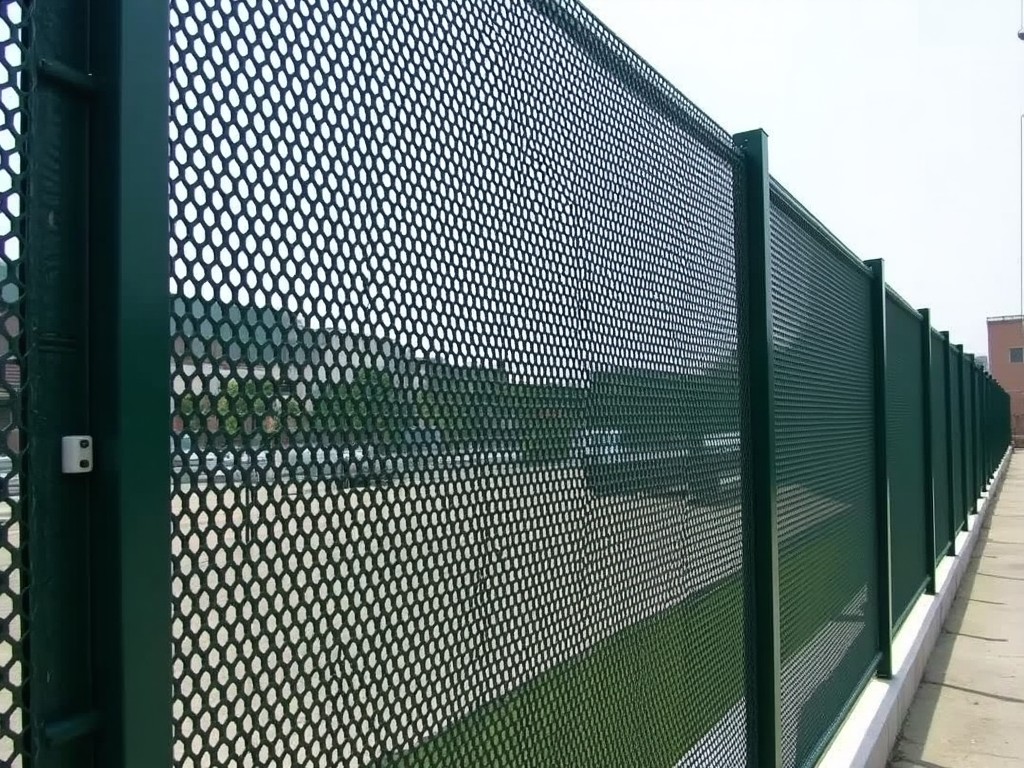
Direct Factory Perforated Metal Screen Fence
A perforated metal screen fence is produced by punching regular arrays of holes through a metal sheet, then forming the sheet into panels that are assembled into a continuous barrier. The process
Request a QuoteDirect Factory Perforated Metal Screen Fence
Overview
A perforated metal screen fence is produced by punching regular arrays of holes through a metal sheet, then forming the sheet into panels that are assembled into a continuous barrier. The process maintains the sheet’s structural integrity while providing controlled airflow, visibility, and light transmission. Panels are typically welded or mechanically fastened to posts, creating a fence that combines security with functional openness.
Because the perforation pattern is defined by tooling, hole diameter, spacing, and arrangement can be precisely controlled to meet specific performance criteria such as shear resistance, climb‑difficulty, or acoustic attenuation. The manufacturing method allows repeatable dimensions across large production runs, which is essential for projects requiring uniform appearance and performance over hundreds of linear meters.
Technical Specifications
| Parameter | Typical Value | Notes |
|---|---|---|
| Base Material Thickness | 0.8 mm – 3.0 mm | Selected based on load requirements and corrosion environment |
| Hole Diameter | 3 mm – 25 mm | Standard round, square, slot, or custom shapes |
| Center‑to‑Center Spacing | 6 mm – 50 mm | Determines open area percentage |
| Open Area Ratio | 15 % – 70 % | Calculated from hole geometry and pitch |
| Panel Height | Up to 3 m (standard) | Custom heights available with additional framing |
| Panel Width | Up to 2.5 m (standard) | Limited by handling and transport constraints |
| Surface Treatment | Hot‑dip galvanizing, powder coating, anodizing (Al) | Chosen per environmental exposure |
Applications
In high‑security perimeter systems, the fence provides a physical barrier while allowing surveillance cameras and motion sensors to maintain clear lines of sight. The open area reduces wind load, lowering the required post embedment depth compared with solid panels.
Architectural projects use perforated screens as façade elements where visual permeability is desired. By selecting a hole pattern that yields a specific shade coefficient, designers can control solar gain and daylighting without additional shading devices.
Industrial facilities install the fence around equipment yards to contain debris and restrict unauthorized access, while still permitting ventilation for heat‑generating machinery. The corrosion‑resistant finishes ensure longevity in environments with chemical exposure or saline air.
Material Options
- Cold‑rolled carbon steel (ASTM A1008) – economical, suitable for indoor or coated outdoor use
- Hot‑dipped galvanized steel (ASTM A653) – zinc coating thickness 55 µm – 200 µm for corrosion resistance
- Stainless steel grade 304 or 316 – chromium‑nickel alloy for harsh chemical or marine environments
- Aluminum alloy 5052 or 6063 – lightweight, naturally oxidizing surface, compatible with anodic coloring
Customization Choices
Hole pattern can be altered to adjust open area, structural stiffness, or aesthetic impact. Common patterns include staggered rows, straight grids, radial layouts, and decorative motifs.
Sheet thickness and material grade are selected according to design loads such as wind pressure, impact resistance, or required service life.
Panel dimensions are tailored to site constraints; longer spans may incorporate intermediate stiffeners or reinforced framing.
Surface finishes range from basic galvanizing to custom‑colored powder coatings that meet specific color‑matching standards (RAL, NCS).
Quality Control Philosophy
Each production lot undergoes dimensional verification of hole diameter, pitch, and panel flatness using calibrated optical gauges. Tolerances are typically ±0.1 mm for hole size and ±0.5 mm for overall panel length.
Material thickness is checked with micrometers at multiple points per sheet to ensure uniformity. Mechanical tests such as tensile strength and yield stress are performed on sample coupons per relevant ASTM standards.
Visual inspection identifies surface defects such as burrs, deformation, or coating inconsistencies. Any panel exceeding defined defect thresholds is reworked or scrapped.
Final assembly checks confirm proper alignment of panels, weld integrity, and fastener torque, guaranteeing that the installed fence meets the specified load‑bearing criteria.
Packaging & Shipping
Panels are stacked on pallets with protective edge guards and separated by corrugated sheets to prevent abrasion during transit. Each pallet is stretch‑wrapped and secured with steel straps.
For overseas shipments, pallets are placed inside fumigated wooden crates that conform to ISPM‑15 standards, reducing the risk of pest‑related delays at customs.
Loading plans optimize container utilization, typically fitting 20–30 m² of fence per standard 20‑foot container, depending on panel dimensions.
Frequently Asked Questions
- Can dimensions be customized? Yes. Panel height, width, hole size, and pattern are adjusted per project drawings. Provide the required open area and load specifications for a quote.
- What information is needed before quotation? Required details include material preference, thickness, hole diameter, spacing, panel size, quantity, surface finish, and delivery destination.
- Which materials are available? Carbon steel, galvanized steel, stainless steel (304/316), and aluminum alloys are stocked. Specialty alloys can be sourced upon request.
- How is quality inspected? Dimensional checks, material thickness verification, mechanical testing on coupons, and visual inspection for surface defects are standard procedures.
- What packaging options exist? Palletized with edge protection, stretch‑wrapped, and strapped; export crates available for international shipments.
- How are export shipments protected? Pallets are placed in ISPM‑15 compliant wooden crates, sealed, and labeled with handling instructions.
- What is the typical lead time? Production lead time ranges from 2–4 weeks after drawing approval, depending on material availability and order volume.
- Are samples provided? Sample panels (up to 300 mm × 300 mm) can be shipped upon request; shipping costs are borne by the requester.
To discuss your specific perforation requirements, material selection, or to request a formal quotation, please contact our technical sales team.
Request Quote


