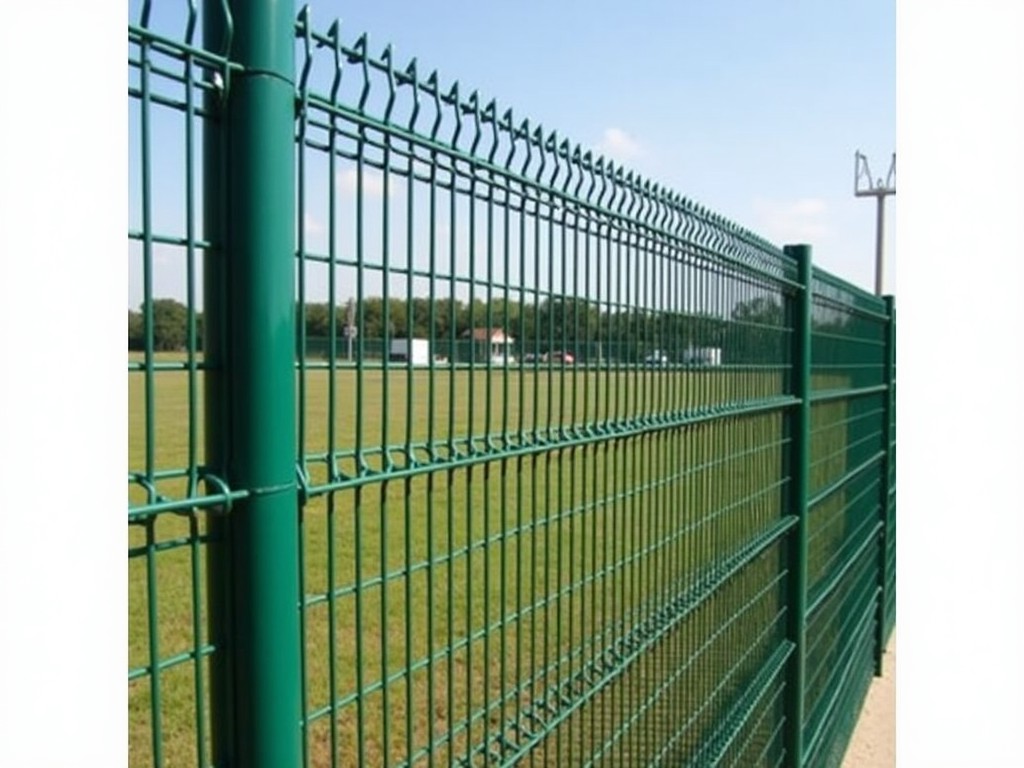
Custom Slatted Chain Link Fence Supplier
Slatted chain link fences combine a standard diamond mesh with vertical or horizontal slats that fill the openings, providing visual privacy while retaining the fence’s structural openness. This
Request a QuoteCustom Slatted Chain Link Fence Supplier
Slatted chain link fences combine a standard diamond mesh with vertical or horizontal slats that fill the openings, providing visual privacy while retaining the fence’s structural openness. This configuration is chosen when a site requires both airflow and a barrier to sight lines, such as around storage yards, recreational facilities, or industrial perimeters.
Material Selection
The core mesh is typically formed from low‑carbon steel wire, with diameters ranging from 2.0 mm to 4.0 mm depending on load requirements. To resist corrosion, the wire can be galvanized (zinc coating ≥ 55 g/m²) or coated with a polyvinyl chloride (PVC) layer that adds 0.3 mm to 0.5 mm thickness. Slats themselves are offered in extruded PVC, powder‑coated aluminum, or treated wood composites, each chosen for specific UV stability, weight, and maintenance intervals.
- Galvanized steel mesh – tensile strength ≈ 400 MPa, elongation 20 %
- PVC‑coated mesh – coating thickness 0.3‑0.5 mm, UV stabilizer added
- Extruded PVC slats – density 1.4 g/cm³, colorfast for 5‑7 years
- Powder‑coated aluminum slats – weight 2.7 g/cm³, corrosion resistance > 1500 h salt spray
Design Parameters and Customization
Mesh opening size (the diamond pitch) is selected from 40 mm to 100 mm, influencing both visibility and climb resistance. Slat width typically ranges from 25 mm to 75 mm, with spacing between slats adjustable from 0 mm (solid appearance) to 30 mm for partial sight. Fence height can be fabricated in 1 m increments up to 3.6 m, and posts are sized to match the selected wire gauge and wind load.
| Parameter | Typical Range | Notes |
|---|---|---|
| Mesh wire diameter | 2.0 mm – 4.0 mm | Determines tensile strength and impact resistance |
| Mesh opening (pitch) | 40 mm – 100 mm | Smaller pitch increases privacy and climb resistance |
| Slat width | 25 mm – 75 mm | Affects material usage and visual profile |
| Slat spacing | 0 mm – 30 mm | 0 mm yields solid barrier; larger spacing adds airflow |
| Fence height | 1.0 m – 3.6 m | Custom heights available in 0.1 m increments |
Manufacturing Process
First, the steel wire is drawn to the specified diameter and then woven into the diamond pattern on a high‑speed loom. After weaving, the mesh passes through a coating line where either a hot‑dip zinc bath or a PVC extrusion applies the protective layer. Finally, slats are inserted mechanically or manually, tensioned to uniform pressure, and the finished panels are cut to length, welded or clamped to posts, and prepared for shipment.
- Wire drawing and annealing
- Loom weaving of diamond mesh
- Galvanizing or PVC coating
- Slat insertion and tensioning
- Panel cutting, post attachment, quality check
Quality Control and Testing
Dimensional checks verify wire diameter, mesh pitch, and panel squareness within ±2 mm tolerance. Coating adhesion is assessed using ASTM D3359 tape test, with a minimum rating of 4B required for PVC layers. Visual inspection looks for uniform slat alignment, absence of coating defects, and proper tension across the mesh.
- Wire diameter measurement (micrometer)
- Mesh pitch verification (caliper)
- Coating thickness gauge (mils)
- Adhesion tape test (ASTM D3359)
- Visual slat alignment check
Typical Applications
In storage yards, the slatted design prevents casual visual inspection of contents while still allowing wind to pass, reducing wind load on the fence structure. Around sports facilities, the fence provides a visual barrier that does not trap heat, helping maintain comfortable playing conditions. Industrial perimeters benefit from the combination of climb resistance (small mesh pitch) and privacy, deterring unauthorized observation of equipment.
- Storage and logistics yards – visual privacy, wind permeability
- Sports complexes and recreational areas – glare reduction, spectator shielding
- Utility substations and telecom sites – obstruction of line‑of‑sight, limited climbability
- Municipal boundaries – aesthetic integration with landscaping
Frequently Asked Questions
- Can the mesh size and slat dimensions be customized?
- Yes. Mesh pitch, wire gauge, slat width, and spacing are all selected per project requirements and produced to tolerance.
- What information is needed to obtain a quotation?
- Required details include fence height, total linear length, mesh opening, wire diameter, coating type, slat material, and any post or gate specifications.
- Which slat materials are available?
- Options are extruded PVC, powder‑coated aluminum, and treated wood‑composite slats, each with distinct UV stability and maintenance profiles.
- How is quality inspected before shipment?
- Each panel undergoes dimensional verification, coating adhesion testing, and visual alignment checks as described in the quality control section.
- What packaging methods protect the finish during transit?
- Panels are stacked with protective interleaving, wrapped in stretch film, and placed on pallets with corner guards to prevent coating abrasion.
- What is the typical production lead time?
- Lead time varies with size and coating, but standard orders are usually completed within 3‑4 weeks after design confirmation.
To discuss your specific slatted chain link fence requirements, request a quote or technical datasheet.
Contact Sales Team


