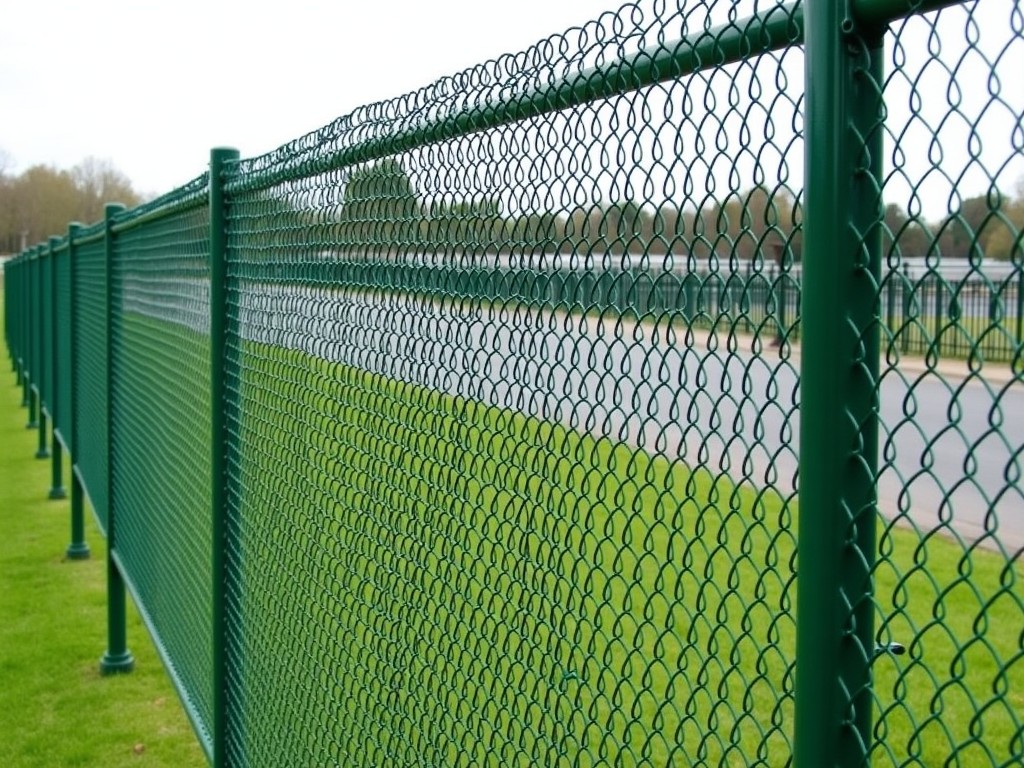
Custom Removable Chain Link Fence Manufacturer
Removable chain link fencing provides a temporary yet secure barrier that can be installed and dismantled without permanent groundworks. The system relies on socket‑set posts and clamp‑based panels,
Request a QuoteCustom Removable Chain Link Fence Manufacturer
Removable chain link fencing provides a temporary yet secure barrier that can be installed and dismantled without permanent groundworks. The system relies on socket‑set posts and clamp‑based panels, allowing repeated reuse across multiple projects.
Typical applications include construction site perimeters, event crowd control, utility maintenance zones, and military training areas where rapid deployment and retrieval are required.
Material Options and Engineering Characteristics
The core fabric is formed from cold‑drawn steel wire, available in plain galvanized, zinc‑aluminum alloy, or stainless steel grades. Wire diameters typically range from 2.0 mm to 4.0 mm, influencing tensile strength and impact resistance.
Coating choices affect corrosion life in different environments. Hot‑dip galvanizing provides a zinc layer of 55 µm to 85 µm, suitable for most outdoor conditions. For higher chemical exposure, a PVC over‑coat of 0.3 mm to 0.5 mm adds a barrier against chlorides and UV degradation.
Stainless steel wire (grade 304 or 316) eliminates the need for additional coating and maintains mechanical properties in saline or acidic atmospheres, though at a higher material cost.
Design Parameters Influencing Performance
Panel height is selected based on the required deterrence level; common heights are 1.2 m, 1.5 m, 1.8 m, 2.1 m, and up to 3.0 m for high‑security zones. Post spacing generally follows the panel width, with typical centers of 2.5 m to 3.0 m to limit deflection under wind load.
The removable mechanism uses a steel socket welded to the post base and a corresponding collar on the panel. A quick‑release bolt or pin secures the collar, allowing removal with standard hand tools in under two minutes per panel.
Wind load capacity is calculated using the drag coefficient of the mesh and the solidity ratio. For a 50 mm × 50 mm mesh with 2.5 mm wire, the system can sustain gusts up to 150 km/h when posts are grouted to a depth of 600 mm in compacted soil.
Customization Choices
- Height: 1.0 m to 3.5 m in 0.1 m increments
- Mesh aperture: 30 mm × 30 mm to 100 mm × 100 mm
- Wire diameter: 1.8 mm to 5.0 mm
- Coating: galvanized, galvanized+PVC, powder‑coated (RAL colors), stainless steel
- Post type: socket‑set, flange‑base, or driven‑spike for temporary soils
- Gate options: single‑leaf, double‑leaf, sliding, with matching removable hinges and latch plates
Typical Specification Table
| Parameter | Typical Range | Customizable According to Project Requirements |
|---|---|---|
| Wire Diameter | 2.0 mm – 4.0 mm | 1.8 mm – 5.0 mm (galvanized, SS) |
| Mesh Opening | 50 mm × 50 mm – 100 mm × 100 mm | 30 mm × 30 mm – 150 mm × 150 mm |
| Post Diameter | 48 mm – 76 mm | Up to 114 mm for heavy‑load posts |
| Panel Height | 1.2 m – 3.0 m | Up to 3.5 m with reinforced posts |
| Zinc Coating Thickness | 55 µm – 85 µm (hot‑dip) | Up to 120 µm on request |
| PVC Over‑coat | 0.3 mm – 0.5 mm | Custom colours, 0.1 mm – 0.8 mm |
| Wind Load Resistance | Up to 150 km/h (standard installation) | Higher with deeper foundations or bracing |
| Removable Mechanism | Socket‑type with quick‑release pin | Bolt‑lock, wedge‑clamp, or magnetic release options |
Quality Control Philosophy
Each production lot undergoes tensile testing of wire samples to verify minimum yield strength (typically ≥ 350 MPa for galvanized steel). Coating thickness is measured with a magnetic inductance probe at five random points per panel, ensuring uniformity within ±5 µm.
Panel flatness is checked using a straight‑edge and feeler gauge; deviation over a 1 m length must not exceed 3 mm. Removable hardware is cycled 500 times to confirm latch retention force remains above 150 N.
Final inspection includes visual assessment for weld defects, coating continuity, and correct dimensions. Documentation of test results is provided with each shipment upon request.
Typical Applications and Why the Removable Design Fits
Construction sites benefit from the ability to reposition the fence as work fronts advance, reducing the need for multiple permanent installations. The socket‑set posts leave minimal ground disturbance, allowing quick reinstatement of the original surface after removal.
Event organizers use removable panels to create secure perimeters that can be erected the day before an event and dismantled within hours afterward, saving labor and storage costs compared to fixed barriers.
Utility crews working on live pipelines or cables value the non‑conductive options (PVC‑coated or stainless steel) and the ability to ground the fence safely when required.
Military and security agencies deploy the system for temporary training areas or forward operating bases, where the fence must withstand repeated deployment cycles without degradation of the locking mechanism.
Frequently Asked Questions
- Can dimensions be customized? Yes, height, mesh size, wire diameter, and post type are all adjustable to meet site‑specific load and security requirements.
- What information is needed for a quotation? Required details include desired height, total length, mesh specification, coating preference, gate quantities, and site conditions (soil type, wind exposure).
- Which materials are available? Plain galvanized steel, zinc‑aluminum alloy, PVC‑over‑coated galvanized, and stainless steel grades 304/316.
- How is quality inspected? Each lot receives tensile, coating thickness, flatness, and hardware cycle tests; results are traceable via batch numbers.
- What packaging methods are used? Panels are bundled in stretch‑wrapped pallets with corner protectors; posts are packed in wooden crates or steel frames to prevent deformation.
Contact our engineering team to discuss your project requirements and receive a detailed quotation.



