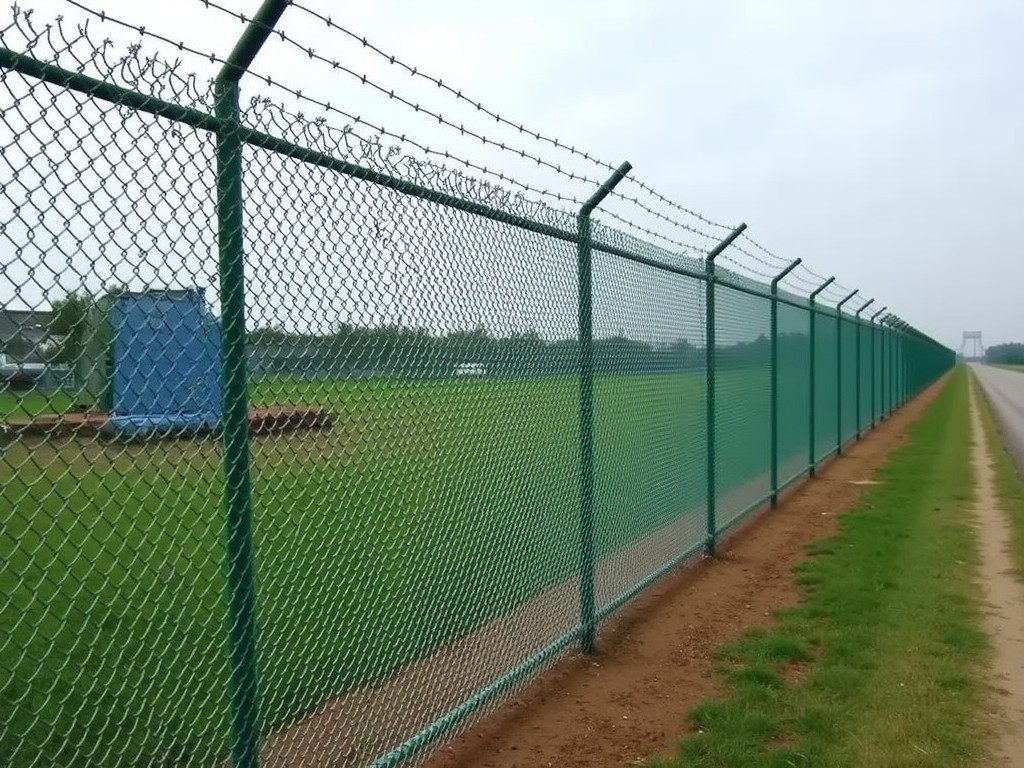
Custom Galvanized Chain Link Fence With Barbed Wire Supplier
Custom galvanized chain link fence with barbed wire combines a woven steel mesh core, a protective zinc coating, and strategically placed barbed strands to deter climbing and cutting. The mesh is
Request a QuoteCustom Galvanized Chain Link Fence With Barbed Wire Supplier
Overview
Custom galvanized chain link fence with barbed wire combines a woven steel mesh core, a protective zinc coating, and strategically placed barbed strands to deter climbing and cutting. The mesh is formed from cold‑drawn steel wire, interlocked in a uniform pattern, then passed through a hot‑dip galvanizing line to achieve a consistent coating weight. Barbed wire is helically wound onto selected posts or tension wires at prescribed intervals, creating a physical barrier that increases penetration resistance. This configuration is commonly specified for perimeter security where both corrosion resistance and mechanical toughness are required.
Technical Specifications
Standard specifications are expressed in terms of wire diameter, mesh opening, fence height, and barbed wire geometry. These parameters directly affect load‑bearing capacity, deflection under wind pressure, and the effort required to breach the barrier.
- Wire diameter (core mesh): 9 ga (3.8 mm) or 10 ga (3.4 mm) cold‑drawn steel
- Mesh opening: 50 mm × 50 mm (2″ × 2″) or 75 mm × 75 mm (3″ × 3″)
- Fence height: 1.2 m to 3.0 m in 150 mm increments
- Barbed wire: 2‑point or 4‑point barbs, spaced 50 mm to 75 mm along the tension wire
- Zinc coating weight: minimum 275 g/m² (hot‑dip galvanized per ASTM A123)
- Tensile strength of steel wire: ≥ 350 MPa
Material & Coating
The zinc coating provides sacrificial protection; when the coating is locally damaged, zinc corrodes preferentially to shield the underlying steel. Coating thickness is measured in grams per square meter and correlates with service life in various atmospheric conditions. For industrial environments with moderate sulfur dioxide levels, a 275 g/m² coating typically yields 15‑20 years before maintenance recoating is advised. The steel wire itself is produced from low‑carbon steel (C ≤ 0.10 %) to ensure ductility during weaving and impact resistance.
Customization Options
Buyers can tailor the fence to site‑specific security levels, aesthetic constraints, and installation logistics. Adjustable variables include mesh gauge, opening size, height, post type, barbed wire configuration, and coating class.
- Mesh gauge: 8 ga (4.2 mm) to 11 ga (3.0 mm)
- Opening size: 38 mm, 50 mm, 75 mm, or custom
- Height: up to 4.0 m with optional overhang
- Post options: galvanized steel H‑post, concrete‑filled tubular, or wood‑core steel
- Barbed wire: 2‑point, 4‑point, or razor‑type; spacing 25 mm‑100 mm
- Coating class: standard (275 g/m²), heavy (400 g/m²), or marine‑grade (550 g/m²)
Applications
In high‑security perimeters such as substations, correctional facilities, and industrial yards, the combination of a rigid mesh and barbed barrier raises the time and tools required for unauthorized entry. The open‑mesh design allows visibility for surveillance cameras while preventing concealment of objects. Corrosion‑resistant coating ensures long‑term performance in coastal or chemically aggressive atmospheres where untreated steel would suffer rapid rust‑induced loss of strength.
Quality Control & Testing
Each production lot undergoes dimensional verification, coating adhesion tests, and mechanical strength checks to confirm conformity with order specifications. Non‑destructive methods such as magnetic flux leakage scanning detect thin spots in the zinc layer, while tensile testing of wire samples validates yield strength.
| Test | Acceptance Criterion |
|---|---|
| Mesh opening tolerance | ± 2 mm of nominal |
| Zinc coating weight | ≥ 275 g/m² (ASTM A123) |
| Wire tensile strength | ≥ 350 MPa |
| Barbed wire pull‑off resistance | ≥ 1.5 kN per barb |
Installation Considerations
Proper installation begins with setting posts at the specified depth and alignment, using concrete footings or driven anchors as dictated by soil conditions. The mesh is unrolled, attached to tension wires with hog‑ring or zip‑tie fasteners, and stretched to eliminate sag. Barbed wire is then helically wound onto the top tension wire at the prescribed pitch, ensuring uniform spacing and sufficient protrusion to deter grasping. Tension is re‑checked after temperature changes to maintain barrier integrity.
Packaging & Shipping
Panels are rolled onto wooden pallets, protected with UV‑stabilized polyethylene stretch film, and secured with steel straps. Each pallet is labeled with part number, dimensions, coating class, and quantity. For export shipments, pallets are placed inside ISO‑rated containers with moisture‑absorbing desiccants and undergo fumigation if required by destination regulations. This packaging method limits mechanical deformation and prevents water ingress during transit.
FAQ
Common questions from procurement engineers and project managers are addressed below.
- Can dimensions be customized? Yes – wire gauge, opening size, height, and barbed wire spacing are all adjustable per project requirements.
- What information is required before quotation? Required data include desired fence height, total linear footage, mesh gauge, opening size, barbed wire type, coating class, and any special post or gate specifications.
- What materials are available? Core steel wire is low‑carbon, cold‑drawn; coating options are hot‑dip galvanized with selectable weight; posts are offered in galvanized steel, concrete‑filled tubular, or wood‑core steel.
- How is quality inspected? Each lot undergoes dimensional checks, coating weight verification (gravimetric or X‑ray fluorescence), and tensile testing of wire samples per ASTM standards.
- What packaging methods are available? Standard packaging uses palletized rolls with stretch film and steel straps; custom crating or container‑specific solutions can be arranged.
- How are export shipments protected? Pallets are wrapped in moisture‑barrier film, fitted with desiccant packs, and secured inside sealed containers; additional fumigation or heat treatment is provided upon request.
- What is the typical production lead time? Lead time ranges from 2‑4 weeks for standard configurations; customized orders may require an additional week for tooling and coating adjustments.
- How are samples arranged? Sample sections (typically 1 m × 1 m) can be shipped via express courier upon receipt of a purchase order or proforma invoice.



