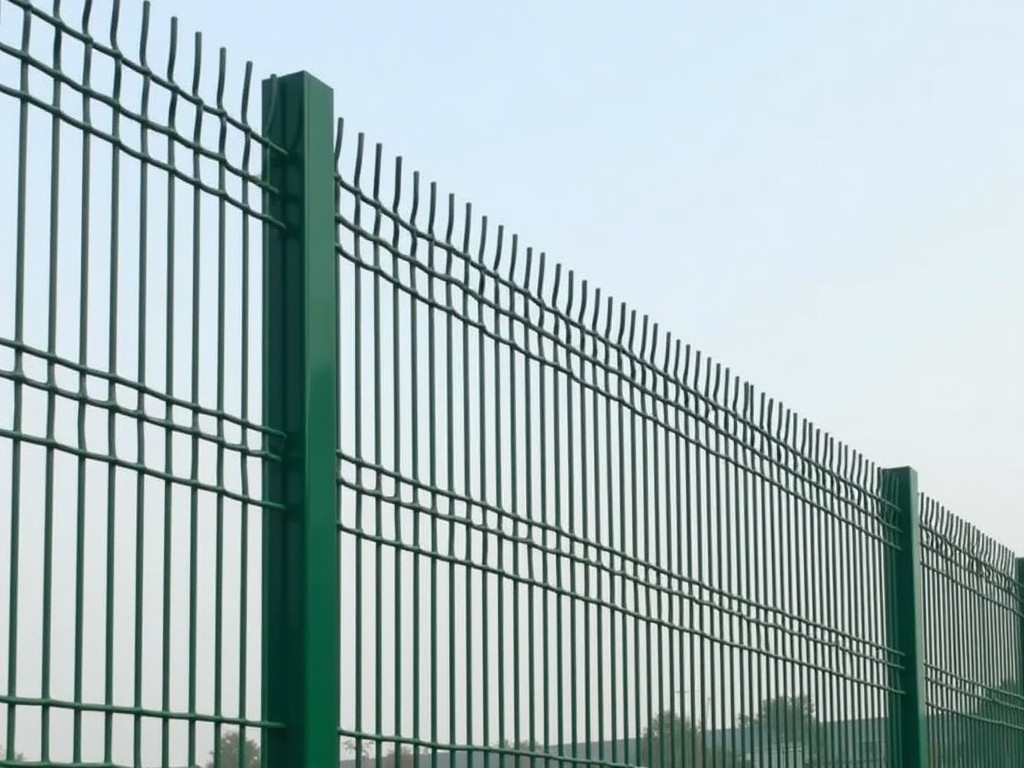
Custom Clear View Metal Mesh Fence Factory
The clear view metal mesh fence combines high tensile steel wires with a transparent polymer coating to provide visibility while maintaining perimeter security. The mesh opening size is typically 50
Request a QuoteCustom Clear View Metal Mesh Fence
Overview
The clear view metal mesh fence combines high tensile steel wires with a transparent polymer coating to provide visibility while maintaining perimeter security. The mesh opening size is typically 50 mm × 50 mm, and wire diameter ranges from 3 mm to 6 mm depending on load requirements.
Material Specification
Core wires are cold‑drawn low‑carbon steel (grade Q195) with a minimum yield strength of 345 MPa. The polymer coating is a UV‑stabilized polyethylene blend, thickness 0.2 mm, offering corrosion resistance equivalent to ISO 12944‑5 C3.
| Parameter | Typical Value | Customizable Range |
|---|---|---|
| Wire diameter | 4 mm | 3 mm – 6 mm |
| Mesh opening | 50 mm × 50 mm | 25 mm – 100 mm |
| Coating thickness | 0.2 mm | 0.15 mm – 0.3 mm |
| Tensile strength | 550 MPa | 500 MPa – 650 MPa |
Design and Customization
Panel height can be specified from 1.2 m to 3.0 m in 0.1 m increments. Post spacing is typically 2.5 m centre‑to‑centre, adjustable to accommodate terrain variations. The fence system supports both welded and mechanical‑clamp panel assembly methods.
Optional features include integrated anti‑climb spikes, glare‑reducing matte finish, and powder‑coated post colors matched to RAL standards.
Structural Performance
When installed with concrete‑filled steel posts (diameter 114 mm, wall thickness 4 mm), the fence withstands a uniform lateral load of 1.5 kN/m without permanent deflection. Impact resistance tested per EN 1317‑3 shows a maximum dynamic force absorption of 8 kJ at 20 km/h vehicle impact.
Corrosion testing in salt‑spray chambers (ASTM B117) shows less than 5 µm coating loss after 1000 h exposure, meeting C4 durability classification.
Typical Applications
The transparent mesh design is chosen where visual monitoring is required without compromising barrier integrity.
- Airside perimeter zones at airports, enabling clear sightlines for ground‑crew and security cameras.
- Railway right‑of‑way fencing where track inspection visibility is essential.
- Industrial facility boundaries adjacent to public roads, allowing drivers to see hazards while preventing unauthorized entry.
- Sports stadium perimeters where spectators need an unobstructed view of the field.
Quality Assurance
Each production lot undergoes dimensional verification using laser‑scanned profiles, with tolerances of ±0.5 mm on wire diameter and ±2 mm on mesh pitch. Mechanical testing includes tensile, bend, and coating adhesion (ASTM D3359) on a sample size of 5 % of panels.
Final inspection checks for coating uniformity, weld integrity (if applicable), and correct panel dimensions before packaging. Documentation includes material test reports and a conformity certificate per ISO 9001:2015.
Packaging and Logistics
Panels are stacked flat on steel pallets, separated by corrugated cardboard layers, and secured with PET straps. Standard pallet size is 1.2 m × 1.0 m, holding up to 20 panels depending on height. Protective corner guards prevent edge damage during transit.
For overseas shipments, the factory provides fumigated wooden crates or ISPM‑15 compliant pallets, and includes moisture‑absorbent desiccant packs to maintain coating integrity.
Frequently Asked Questions
Can dimensions be customized?
Yes. Panel height, width, wire diameter, mesh opening, and coating thickness are all adjustable to project specifications.
What information is required before quotation?
Required data includes total fence length, desired height, post spacing, any special features (e.g., anti‑climb, color), and delivery destination.
How is quality inspected?
Inspection comprises dimensional laser scanning, mechanical tensile tests, coating adhesion checks, and visual verification of welds or clamps.
What packaging methods are available?
Standard palletized flat stacks with cardboard separators and PET straps; optional wooden crates or ISPM‑15 pallets for export.
Request a Quote
To discuss your project requirements, provide the details listed in the FAQ section. Our engineering team will return a detailed quotation with lead times and shipping options.
Contact Us


