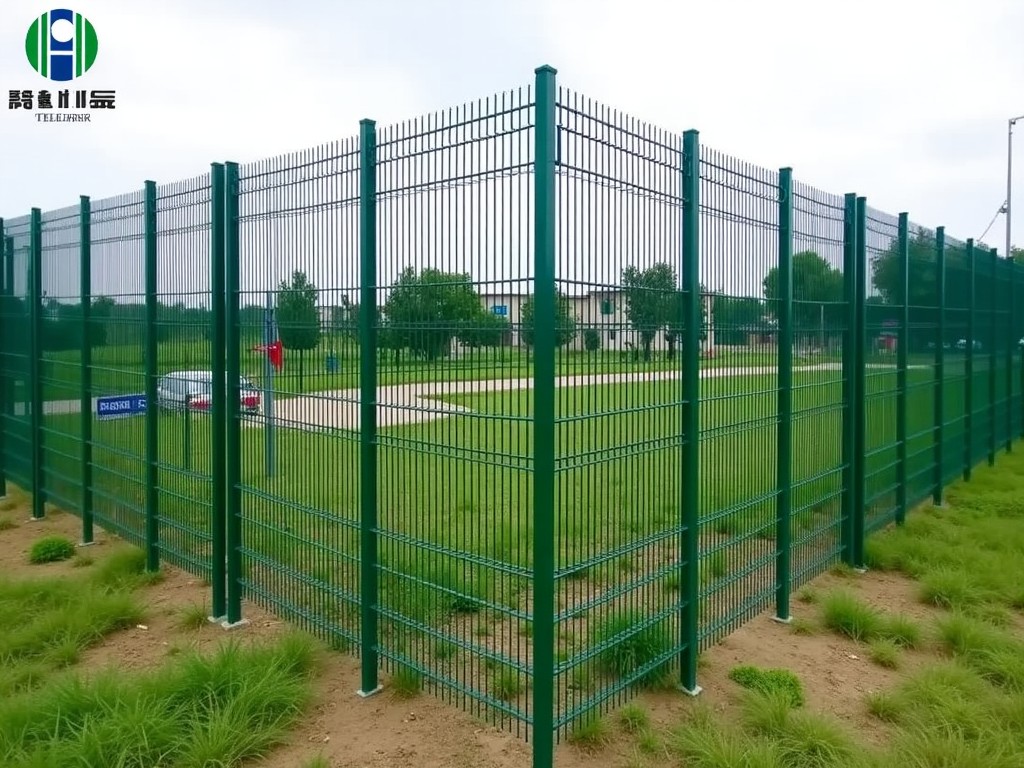
China Steel Perimeter Fencing Panels Supplier
Perimeter fencing panels fabricated from structural steel provide a continuous barrier that resists impact, prevents unauthorized access, and defines site boundaries. The panels are engineered to be
Request a QuoteChina Steel Perimeter Fencing Panels Supplier
Perimeter fencing panels fabricated from structural steel provide a continuous barrier that resists impact, prevents unauthorized access, and defines site boundaries. The panels are engineered to be installed on steel or concrete posts with minimal site welding, allowing rapid deployment for infrastructure, industrial, and commercial projects.
Materials and Construction
The primary material is hot‑rolled Q235B steel, selected for its yield strength of approximately 235 MPa and good weldability. Panel thickness options range from 1.5 mm to 3.0 mm, determined by the required load rating and span between posts. All steel surfaces undergo hot‑dip galvanizing to achieve a zinc coating thickness of 55–70 µm, providing corrosion resistance in accordance with ISO 1461.
Panel frames are formed by bending the steel sheet into a rectangular profile, while the infill consists of welded wire mesh or perforated sheet. Welds are executed using MIL‑STD‑2220 compliant procedures, with visual inspection and ultrasonic testing performed on a sampling basis to verify weld integrity.
Design Features
Standard panel heights are 1.2 m, 1.5 m, 1.8 m, and 2.4 m, with widths adjustable in 100 mm increments up to 3.0 m to suit site layouts. Mesh openings are typically 50 mm × 50 mm for security applications, while 75 mm × 75 mm or 100 mm × 100 mm configurations are available for reduced wind load and material cost.
Each panel includes pre‑drilled mounting holes spaced at 600 mm intervals along the vertical edges, compatible with standard post brackets. Edge flanges are reinforced with a 20 mm return to increase bending resistance and facilitate panel‑to‑panel alignment without additional couplers.
Typical Specifications
| Parameter | Typical Value | Notes |
|---|---|---|
| Steel Grade | Q235B | Yield strength ≈235 MPa |
| Thickness | 1.5 mm – 3.0 mm | Selected per design load |
| Coating | Hot‑dip Zn 55–70 µm | ISO 1461 compliant |
| Mesh Opening | 50 mm × 50 mm (standard) | Alternative sizes available |
| Weight (per m²) | 12–20 kg | Depends on thickness & infill |
Applications
Perimeter fencing panels are selected when a durable, low‑maintenance barrier is required to delineate property lines, protect critical equipment, and control pedestrian or vehicular flow. The structural steel construction provides resistance to accidental impact from equipment or vehicles, while the galvanized finish extends service life in outdoor environments exposed to moisture, UV, and industrial pollutants.
- Utility substations: Panels enclose transformers and switchgear, meeting safety clearance regulations and deterring unauthorized entry.
- Transportation terminals: Used along railway platforms and bus depots to guide passenger movement and safeguard tracks.
- Industrial yards: Define storage zones for raw materials and finished goods, reducing theft and improving inventory control.
- Construction site perimeters: Provide temporary yet robust boundary protection that can be relocated as project phases progress.
Customization Options
Beyond standard dimensions, panels can be tailored to meet specific project criteria. Height adjustments are achieved by altering the vertical panel length, while width modifications involve changing the number of mesh panels welded into the frame. Coating alternatives include powder‑coated finishes in RAL colors for aesthetic integration or epoxy‑based systems for aggressive chemical environments.
Additional features such as anti‑climb spikes, razor‑wire brackets, or integrated access gates can be fabricated as part of the panel assembly. All customizations are documented in shop drawings that reference the base panel design, ensuring compatibility with standard post brackets and installation procedures.
Quality Control and Testing
Each production lot undergoes dimensional verification using calibrated calipers and laser scanners to confirm height, width, and hole placement within ±2 mm tolerances. Coating thickness is measured with a magnetic induction gauge on at least five random points per panel, with results logged against the target 55–70 µm range.
Weld quality is assessed through visual inspection per AWS D1.1 and supplementary ultrasonic spot checks on 10 % of welds. Load testing simulates a uniform lateral pressure of 1.5 kN/m² to verify frame rigidity; deflection is recorded and must remain below L/200 where L is the panel span.
Packaging and Shipping
Finished panels are stacked flat on wooden pallets, with interleaving layers of polyethylene film to prevent surface abrasion. Edge protectors made of corrugated cardboard are applied to all four sides, and the entire pallet is secured with polypropylene straps. For overseas shipments, pallets are placed inside ISO‑standard containers and fitted with desiccant bags to control humidity during transit.
Each pallet bears a label indicating the project reference, panel dimensions, coating type, and quantity. A packing list accompanies the shipment, enabling the receiving party to cross‑check quantities against the purchase order without unpacking.
Frequently Asked Questions
- Can dimensions be customized? Yes, panel height and width are adjustable in 50 mm increments; non‑standard sizes require a new drawing approval.
- What information is required before quotation? Required data include desired height, width, mesh opening, coating preference, post type, and any accessories such as gates or spikes.
- What materials are available? Standard is hot‑dip galvanized Q235B steel; optional grades include Q345B for higher strength and stainless steel 304/316 for corrosive environments.
- How is quality inspected? Dimensional checks, coating thickness measurement, weld visual and ultrasonic inspection, and load deflection testing are performed per lot.
- What packaging methods are available? Panels are palletized with film interleaving, edge protectors, and strap securing; custom crating is available on request.



