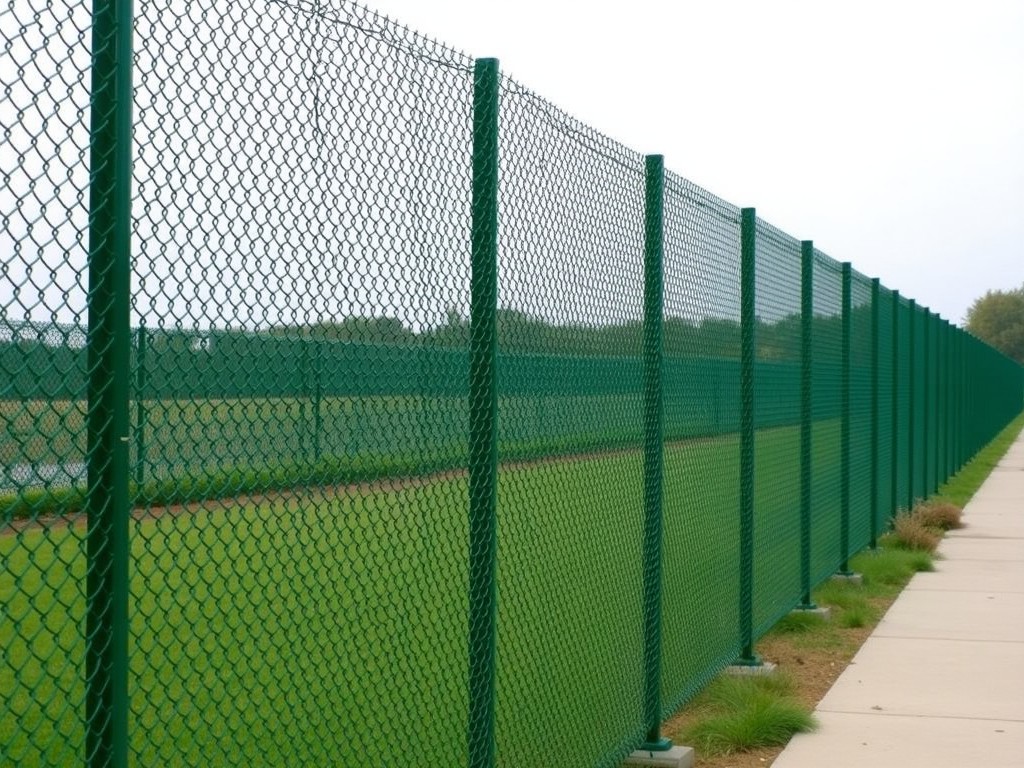
China Standard Residential Chain Link Fence Manufacturer
Residential chain link fences are formed by interlocking steel wires woven into a uniform diamond pattern, then tensioned between posts to create a continuous barrier. The manufacturing process
Request a QuoteChina Standard Residential Chain Link Fence Manufacturer
Residential chain link fences are formed by interlocking steel wires woven into a uniform diamond pattern, then tensioned between posts to create a continuous barrier. The manufacturing process begins with cold‑drawn steel wire, which is galvanized or coated to resist corrosion before being formed into the characteristic mesh. This method produces a fence that offers visibility, airflow, and a predictable load‑bearing capacity while remaining economical for large‑scale housing developments.
Technical Specifications
Standard residential mesh uses wire diameters ranging from 2.0 mm to 3.5 mm, selected based on the required tensile strength and local wind load considerations. The nominal opening size is 50 mm × 50 mm, providing a balance between intrusion resistance and visual permeability. Fence heights typically span from 0.9 m to 2.4 m, with incremental steps of 0.3 m to accommodate varying property boundaries and privacy needs.
Material Composition and Coating Options
The base wire is low‑carbon steel (C ≤ 0.12 %) produced to ASTM A641 specifications for cold‑drawn wire. Two primary protective finishes are offered:
- Hot‑dip galvanized coating with a minimum zinc mass of 60 g/m² (ISO 1461), delivering a sacrificial barrier that extends service life in mildly corrosive environments.
- PVC‑coated wire where a 0.5 mm to 0.8 mm polyvinyl chloride layer is extruded over the galvanized core, available in standard colors such as green, black, and white to match landscape aesthetics.
Both finishes are applied in a continuous line process to ensure uniform thickness along the entire wire length, reducing the risk of weak spots that could initiate rust.
Typical Applications in Residential Settings
Chain link fences are selected for residential projects where a combination of security, durability, and cost efficiency is required. The open mesh design allows natural light and airflow to reach gardens and yards while clearly delineating property lines. Common uses include:
- Perimeter fencing for single‑family homes and townhouses, providing a deterrent to trespass without creating a visual barrier.
- Enclosure of recreational areas such as playgrounds, swimming pools, and sports courts, where visibility is essential for supervision.
- Temporary construction site boundaries that can be quickly installed and removed, thanks to the modular post‑and‑panel system.
Because the fence does not obstruct sight lines, it is frequently chosen in communities that enforce architectural guidelines limiting solid barriers.
Manufacturing Process and Quality Assurance
Wire is first drawn to the target diameter, then cleaned and passed through a galvanizing bath where zinc adheres metallurgically to the steel surface. For PVC‑coated variants, the galvanized wire undergoes a pre‑heat treatment before extrusion of the polymer coating. The coated wire is subsequently woven on a high‑speed loom that forms the diamond mesh with precise tolerances (±0.5 mm on opening size).
Quality control incorporates three checkpoints:
- Wire diameter verification using laser micrometers at 10 m intervals.
- Coating thickness measured by magnetic induction (galvanized) or ultrasonic gauges (PVC) with acceptance limits ±10 %.
- Tensile strength testing of finished mesh strips per ASTM A370, ensuring minimum yield strength of 350 MPa for the base steel.
Each roll is labeled with batch number, coating type, and dimensions, enabling traceability from raw material to final shipment.
Customization Parameters
While the standard configuration satisfies most residential projects, several variables can be adjusted to meet specific site conditions:
- Wire diameter: 2.0 mm, 2.5 mm, 3.0 mm, 3.5 mm (custom diameters available upon request).
- Mesh opening: 40 mm × 40 mm, 50 mm × 50 mm, 60 mm × 60 mm (alternative sizes affect rigidity and climb resistance).
- Height: 0.9 m to 3.0 m in 0.1 m increments; optional top rail or tension wire for added stability.
- Coating: galvanized only, galvanized + PVC, or powder‑coated finishes in custom RAL colors.
- Post type: round steel pipe (Ø48 mm, Ø60 mm), square tubular, or concrete‑set posts with base plates.
All customizations are evaluated for structural compatibility; for example, increasing wire diameter necessitates proportionally larger post embedment depth to resist overturning moments.
Comparison Table: Standard vs. Heavy‑Duty Residential Mesh
| Parameter | Standard (2.5 mm wire) | Heavy‑Duty (3.5 mm wire) |
|---|---|---|
| Tensile strength of wire (min.) | 450 MPa | 550 MPa |
| Typical post spacing | 2.5 m | 2.0 m |
| Recommended height limit without additional bracing | 2.4 m | 3.0 m |
| Estimated service life (rural environment) | 15‑20 years (galvanized) | 20‑25 years (galvanized) |
| Weight per linear meter (kg/m) | 1.8 | 3.5 |
Frequently Asked Questions
Can dimensions be customized? Yes. Wire diameter, mesh opening, height, and coating type can be adjusted based on project specifications. Custom lengths are produced in rolls up to 50 m to minimize joints.
What information is required before quotation? We need the desired height, wire diameter, mesh opening, coating preference (galvanized or PVC), post type, and total linear meters. If the fence will retain soil or resist wind loads, a brief site description helps us recommend appropriate post embedment.
How is quality inspected? Each production lot undergoes dimensional verification, coating thickness measurement, and tensile strength testing. Test reports are available upon request and reference the relevant ASTM or ISO standards.
What packaging methods are available? Rolls are wrapped in UV‑stabilized polyethylene film, placed on wooden pallets, and secured with steel straps. For overseas shipments, we add corner protectors and moisture‑absorbent desiccants to prevent corrosion during transit.
What is the typical production lead time? Standard specifications ship within 10‑15 working days after receipt of confirmed purchase order. Custom coating colors or non‑standard mesh sizes may extend lead time to 20‑25 working days.
For detailed technical datasheets, sample requests, or to discuss a specific residential project, please contact our engineering team.
Request a Quote


