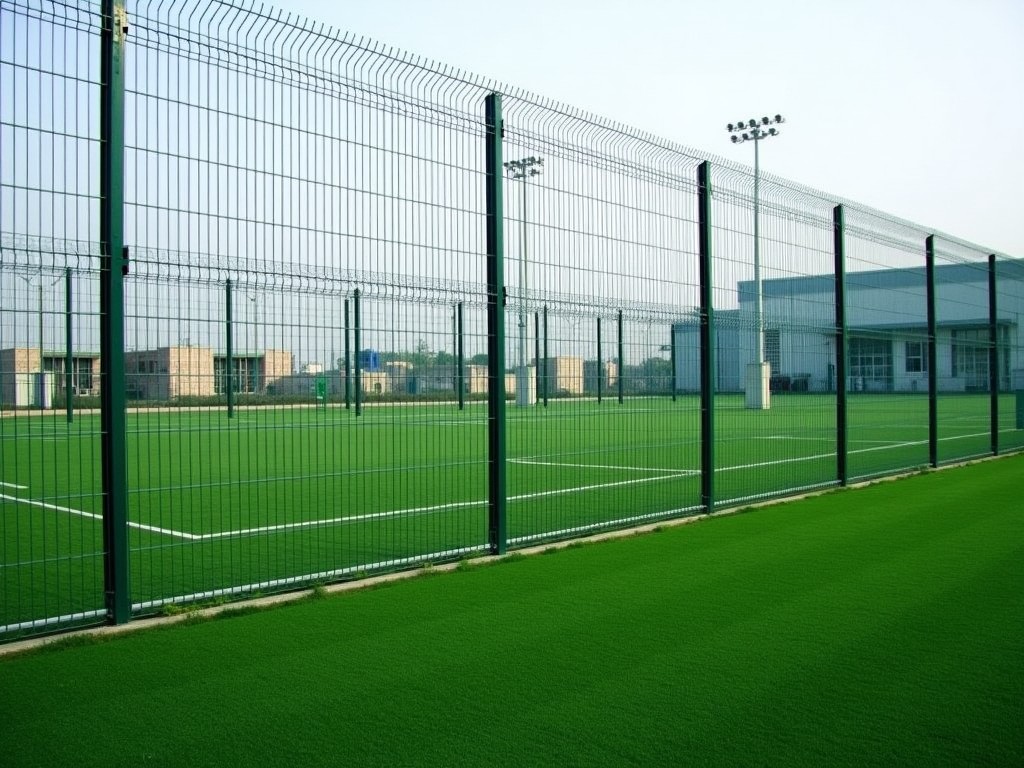
China Soccer Field Perimeter Fencing Factory
Perimeter fencing around a soccer field serves three primary functions: keeping the ball within the playing area, protecting spectators from errant kicks, and delineating the field boundary for
Request a QuoteChina Soccer Field Perimeter Fencing Factory
Perimeter fencing around a soccer field serves three primary functions: keeping the ball within the playing area, protecting spectators from errant kicks, and delineating the field boundary for officials. The system must withstand repeated impact from balls, wind loads, and occasional player contact while maintaining visibility and requiring minimal upkeep.
Product Overview
The fencing consists of vertical posts, horizontal rails, and welded wire mesh panels. Posts are typically circular steel tubes with an outer diameter of 60 mm to 90 mm, set in concrete footings or driven into the ground. Rails run between posts at top and bottom, providing tension to the mesh. The mesh itself is fabricated from low‑carbon steel wire, welded at each intersection to form a uniform opening size.
Material Specifications
| Component | Material | Typical Thickness / Grade | Corrosion Protection | Tensile Strength (MPa) | Expected Lifespan (years) |
|---|---|---|---|---|---|
| Post (tube) | Structural steel (Q235) | Wall thickness 2.0 mm – 3.0 mm | Hot‑dip galvanized, 55 µm average Zn | ≥ 250 | 20–25 (in mild climate) |
| Rail (tube) | Structural steel (Q235) | Wall thickness 1.8 mm – 2.5 mm | Hot‑dip galvanized, 55 µm average Zn | ≥ 250 | 20–25 |
| Mesh wire | Low‑carbon steel (C1008) | Diameter 3.0 mm – 4.0 mm | Hot‑dip galvanized, 50 µm average Zn; optional PVC coating 0.3 mm | ≥ 350 | 15–20 (galvanized), 25+ (PVC) |
| Concrete footing | C30/37 concrete | Diameter 250 mm, depth 800 mm (typical) | N/A (embedded steel) | ≥ 30 (compressive) | 30+ |
Design and Engineering
Post spacing is determined by the required wind load resistance and panel dimensions. For a standard 2.4 m high fence with 3.0 m wide panels, a center‑to‑center distance of 2.5 m limits deflection under a 30 m/s wind pressure to less than 15 mm. The top and bottom rails are pre‑tensioned to 2 kN, which keeps the mesh taut and reduces ball rebound energy.
Foundations vary with soil conditions. In compacted granular soils, driven steel posts with a concrete plug at the base are sufficient. In softer substrates, a concrete footing of 250 mm diameter and 800 mm depth provides the required embedment depth to resist overturning moments.
Manufacturing Process
Tube sections are cold‑formed from coil, then longitudinally welded using ERW technology. After welding, the assemblies undergo hot‑dip galvanizing in a zinc bath at approximately 450 °C, producing a uniform coating thickness measured by magnetic induction. For colored finishes, a powder‑coat layer is applied electrostatically and cured at 180 °C, delivering a film thickness of 60‑80 µm with UV stability demonstrated by <5% gloss loss after 1000 h UV exposure per ASTM G154.
Mesh panels are produced on automated welding lines where wire is fed at a controlled tension, spot‑welded at each intersection, and then cut to length. Post‑welding, the panels are galvanized together with the frames to ensure consistent corrosion protection across the entire assembly.
Quality Assurance
Dimensional tolerances are verified on a coordinate measuring machine: post length ±2 mm, hole diameter for rail connection ±0.5 mm, and mesh opening size ±1 mm. Coating thickness is checked at five random points per component using a dry‑film thickness gauge; the average must meet the specified zinc weight (≥ 460 g/m²) and the coating must pass a 500‑hour salt‑spray test per ISO 9227.
Mechanical testing includes a tensile test on post samples to confirm yield strength ≥ 235 MPa and an impact test on mesh sections using a 0.5 kg steel ball dropped from 2 m to simulate ball impact; acceptable deflection is less than 10 mm.
Applications
Soccer fields require a barrier that stops the ball without significantly altering its trajectory. A mesh opening of 45 mm to 50 mm provides sufficient ball retention while allowing clear sightlines for spectators and broadcast cameras. A fence height of 2.4 m to 3.0 m satisfies most league regulations for perimeter containment and lowers the probability of balls leaving the field, reducing interruptions and safety hazards.
Beyond match play, the same fencing is used for training grounds, youth pitches, and multi‑use sports complexes where a service life exceeding 20 years and minimal upkeep are required. The galvanized‑plus‑PVC option provides a service life exceeding 25 years in chloride‑rich environments, mitigating corrosion acceleration.
Customization Options
- Height: adjustable from 2.0 m to 4.0 m in 0.1 m increments.
- Mesh opening: 30 mm, 40 mm, 45 mm, 50 mm, 55 mm.
- Post diameter: 60 mm, 76 mm, 89 mm, 102 mm.
- Coating: hot‑dip galvanized only, galvanized + powder coat (RAL colors), galvanized + PVC.
- Integrated components: single‑leaf or double‑leaf gates, lockable access points, ball‑stop nets.
Frequently Asked Questions
Yes. Posts are cut to length on‑site or prefabricated to the exact height required. Panel width is adjusted by varying the distance between posts; standard widths range from 2.0 m to 3.5 m, but non‑standard spans are possible with additional reinforcement.
Q: What information is needed to obtain a quotation?Field perimeter length, desired height, mesh opening, post spacing preference, coating type, and any required accessories (gates, locks). A site plan or CAD drawing helps accelerate the quoting process.
Q: How is the fencing protected against corrosion in humid or salty environments?The base protection is hot‑dip galvanizing, providing a zinc layer of approximately 55 µm. For aggressive environments, an additional PVC overcoat (0.3 mm) or a powder‑coat layer (60‑80 µm) can be applied, extending the service life beyond 25 years.
Q: What is the typical production lead time?For standard specifications, lead time is 3‑4 weeks after receipt of deposit and approved drawings. Custom coatings or non‑standard post sizes may add 1‑2 weeks.
Q: How are shipments protected for export?Components are bundled with protective edge guards, placed on pallets, and wrapped in stretch film. Corrosion‑inhibiting vapor capsules are included inside the packaging to guard against moisture during transit.



