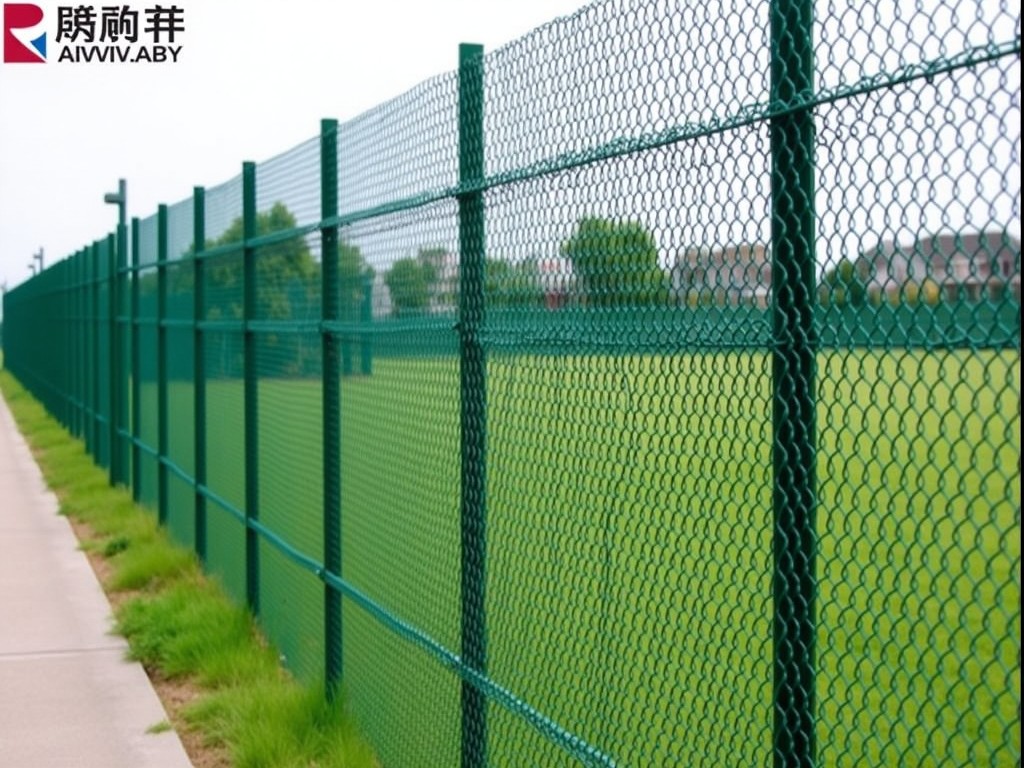
China Six Foot Chain Link Fence Manufacturer
A six‑foot (approximately 1.83 m) chain link fence consists of woven steel wire mesh formed into a uniform diamond pattern, supported by line posts, terminal posts, and a top rail. The standard
Request a QuoteSix Foot Chain Link Fence – Technical Overview
Product Description
A six‑foot (approximately 1.83 m) chain link fence consists of woven steel wire mesh formed into a uniform diamond pattern, supported by line posts, terminal posts, and a top rail. The standard height provides a physical barrier while maintaining visibility and airflow, making it suitable for perimeter security, sports enclosures, and industrial site delineation.
Key Specifications
| Parameter | Typical Value |
|---|---|
| Nominal Height | 6 ft (1.83 m) |
| Mesh Opening (Diamond) | 2 in × 2 in (50 mm × 50 mm) – customizable 1.5‑in to 4‑in |
| Wire Gauge (Core) | 9 ga (3.8 mm) – options 6 ga to 11 ga |
| Coating Type | Hot‑dip galvanized (Zn ≥ 55 g/m²) or PVC‑over‑galvanized (color options) |
| Post Material | Galvanized steel, Ø 2.5 in (60 mm) round or square, wall thickness 1.8 mm |
| Top Rail | Ø 1.5 in (38 mm) galvanized steel, optional PVC‑coated |
| Tensile Strength (Wire) | ≥ 550 MPa (typical for low‑carbon steel) |
Material Options
The base wire is low‑carbon steel drawn to the required gauge. Hot‑dip galvanization applies a zinc metallurgical bond that protects against rust in most environments. For aggressive atmospheres (coastal, chemical plants) a PVC overlay adds a barrier layer; the PVC thickness typically ranges from 0.3 mm to 0.5 mm and is available in colors such as green, black, or white to meet aesthetic or visibility requirements.
Posts and rails receive the same galvanizing treatment; optional hot‑dipped galvanized‑then‑powder‑coat finishes provide additional UV resistance. All metal components are inspected for coating continuity using a holiday detector before assembly.
Manufacturing Process
Production begins with wire drawing to achieve precise diameter and tensile properties. The drawn wire is then woven on a loom into the diamond mesh; the weaving tension is monitored to keep opening dimensions within ±2 mm. After weaving, the mesh passes through a galvanizing bath (or PVC extrusion line) where the coating is applied uniformly.
Posts are cut to length, punched for fence fabric attachment, and coated. Top rails are formed and coated similarly. Final assembly involves attaching the mesh to posts using tension bands, barbed wire ties, or welded clips, followed by securing the top rail. Each finished panel undergoes a dimensional check and a visual coating inspection before packaging.
Applications and Suitability
A six‑foot height provides a deterrent against casual trespass while allowing line‑of‑sight for surveillance cameras and security personnel. In sports facilities, this height prevents balls from leaving the field of play without obstructing spectator views. Industrial sites use it to demarcate storage zones, protect equipment, and control personnel flow; the open mesh reduces wind load compared with solid barriers, lowering structural stress on posts.
Because the fence is lightweight yet strong, installation costs are lower than for welded panel systems. The modular nature allows rapid deployment on uneven terrain; posts can be set in concrete sleeves or driven directly into soil depending on ground conditions.
Quality Control Measures
Every batch of wire is sampled for tensile strength and elongation; results must meet ASTM A641 specifications for galvanized steel wire. Coating weight is verified using a magnetic pull‑off gauge, targeting a minimum of 55 g/m² for zinc. PVC coating adhesion is tested via cross‑hatch and tape methods per ASTM D3359.
Finished panels are subjected to a pull‑test on a sample section to confirm that the mesh‑to‑post connection resists a minimum load of 1.5 kN without deformation. Dimensional checks include height, post spacing, and mesh opening using calibrated gauges. All inspection data are recorded and traceable to the production lot.
Customization Options
- Mesh opening: 1.5 in, 2 in, 2.5 in, 3 in, 4 in (custom upon request)
- Wire gauge: 6 ga to 11 ga (core steel)
- Coating: hot‑dip galvanized, PVC‑over‑galvanized (color: green, black, white, brown)
- Post type: round Ø 60 mm, square 60 × 60 mm, optional flat‑bar terminal posts
- Top rail: Ø 38 mm galvanized, PVC‑coated, or omitted for low‑cost variants
- Accessories: tension bars, brace bands, barbed wire, privacy slats, gate kits
Packaging and Shipping
Panels are rolled or folded, then bundled with corrosion‑inhibiting film and placed on wooden pallets. Each pallet is strapped with polypropylene bands and labeled with part number, quantity, and handling instructions. For overseas shipments, pallets are heat‑treated (IPPC) and wrapped in stretch film to resist moisture ingress during transit.
Standard container load is 20‑pallets per 40‑ft HQ container, approximating 240 panels (depending on panel width). Custom packaging options include crated panels for high‑impact protection or reusable metal stillages for closed‑loop logistics.
Frequently Asked Questions
Yes. Height, mesh opening, wire gauge, and post spacing can be adjusted to meet project specifications. Provide the required parameters for a quotation.
Desired height, length, mesh size, wire gauge, coating type, post material, and any accessories (gates, barbed wire, privacy slats). Site conditions (soil type, wind load) help determine post embed depth.
Each lot undergoes tensile testing of wire, coating weight verification, adhesion testing of PVC, and pull‑testing of assembled sections. Dimensional checks are performed on finished panels before packaging.
Standard palletized bundles with protective film, optional crating for impact resistance, or reusable steel stillages for repeat shipments.
Lead time ranges from 2 to 4 weeks depending on order size and coating selection; exact timing is confirmed at quote.
Contact for Technical Inquiry
For detailed specifications, CAD drawings, or to discuss a custom configuration, please reach out to our engineering team. Providing project details such as total linear footage, site conditions, and required accessories enables us to prepare an accurate quotation and lead‑time estimate.
Request Technical Specification Sheet


