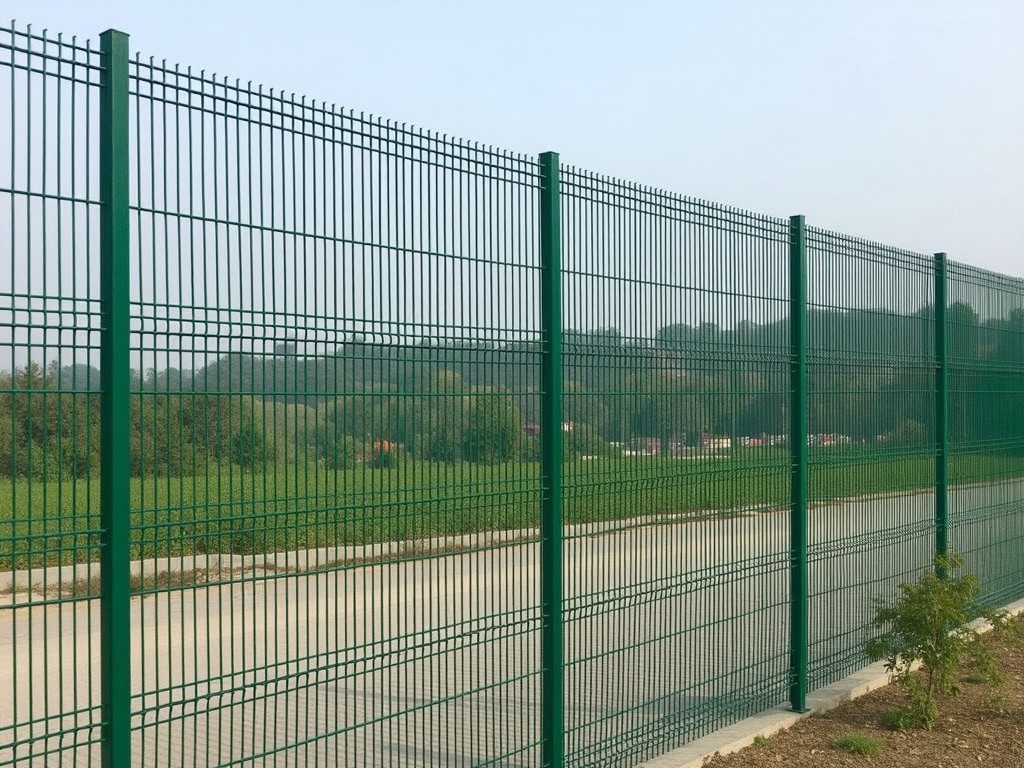
China Metal Mesh Security Fencing Supplier
Metal mesh security fencing consists of welded or woven steel wire panels that form a barrier with defined opening dimensions. The primary function is to deter unauthorized access while maintaining
Request a QuoteChina Metal Mesh Security Fencing Supplier
Overview
Metal mesh security fencing consists of welded or woven steel wire panels that form a barrier with defined opening dimensions. The primary function is to deter unauthorized access while maintaining visibility and airflow. Panels are typically attached to steel posts using brackets, clamps, or direct welding, creating a continuous perimeter system.
Material Selection
The base wire is usually low‑carbon steel with a carbon content between 0.06% and 0.25%, providing a balance of ductility and tensile strength. For environments requiring higher resistance to corrosion, the wire can be hot‑dip galvanized to a zinc coating thickness of 55 µm minimum, or alternatively coated with a PVC or PE extrusion of 0.5 mm to 1.0 mm thickness. Stainless‑steel grades 304 or 316 are available for marine or chemical‑exposure settings, offering chromium content of 16‑18% and nickel content of 8‑10% (304) or 10‑14% with molybdenum 2‑3% (316).
Mesh Geometry & Structural Performance
Opening size, wire diameter, and panel dimensions directly influence load‑bearing capacity and climb resistance. Common configurations include:
- 50 mm × 50 mm square mesh with 3.0 mm wire diameter
- 75 mm × 75 mm square mesh with 4.0 mm wire diameter
- 100 mm × 50 mm rectangular mesh with 3.5 mm wire diameter
Tensile strength of the wire after cold drawing typically ranges from 350 MPa to 550 MPa, depending on carbon content and drawing ratio. Panel rigidity is increased by adding intermediate stiffeners or selecting a smaller opening size, which raises the moment of inertia of the mesh section.
Corrosion Protection & Coating Options
Hot‑dip galvanizing follows ASTM A123/A123M, providing a uniform zinc layer that protects the steel substrate through sacrificial action. For enhanced durability in high‑humidity or saline atmospheres, a duplex system combines galvanizing with a powder‑coat polyester topcoat of 60‑80 µm thickness, delivering a combined barrier and inhibitor effect. PVC extrusion coating offers a flexible, impact‑resistant layer with UV stabilizers, suitable for temporary installations or aesthetic requirements.
Typical Applications
Industrial facilities use mesh fencing to secure storage yards, loading docks, and equipment zones where visibility for surveillance cameras is essential. Transportation infrastructure, such as rail depots and highway rest areas, selects mesh barriers to prevent trespass while allowing wind passage, reducing structural load. Correctional institutions favor smaller opening sizes (e.g., 25 mm × 25 mm) combined with anti‑climb toppings to increase delay time for attempted breaches.
Customization Parameters
Buyers can specify wire diameter from 2.0 mm to 6.0 mm, opening dimensions from 20 mm × 20 mm up to 150 mm × 150 mm, and panel heights ranging from 1.0 m to 3.0 m in 0.5 m increments. Post spacing is adjustable between 2.0 m and 3.5 m, influencing the number of panels per unit length and the overall stiffness of the fence line. Additional options include integrated barbed wire arms, razor‑ribbon toppings, or welded steel plates for increased impact resistance.
Quality Assurance & Testing
Each production lot undergoes dimensional verification using calibrated calipers to confirm wire diameter ±0.05 mm and opening size ±1.0 mm. Tensile testing follows ISO 6892‑1 on wire samples, recording yield and ultimate strength. Coating thickness is measured with a magnetic‑induction gauge per ISO 1460, ensuring zinc layers meet the specified minimum. Visual inspection checks for weld continuity, surface defects, and proper alignment of panel frames before packaging.
Packaging & Logistics
Panels are stacked flat on wooden pallets, with interleaving layers of polyethylene film to prevent abrasion. Each pallet is secured with steel straps and corner protectors, then stretch‑wrapped for moisture resistance. Standard pallet dimensions are 1.2 m × 1.0 m, accommodating up to 20 panels depending on height and weight. For long‑distance shipments, panels can be placed in vertical racks inside containers to minimize handling and reduce the risk of deformation.
Frequently Asked Questions
Can dimensions be customized?
Yes, wire diameter, opening size, panel height, and post spacing are all adjustable according to project requirements. Custom lengths are achievable by cutting panels to size on‑site or by ordering prefabricated lengths.
What information is required before quotation?
To generate an accurate quote, we need the desired mesh geometry (wire diameter and opening), total linear length, height, coating preference (galvanized, PVC, powder‑coat, or stainless), post type and spacing, and any additional features such as toppings or gates.
What materials are available?
Available base materials include low‑carbon steel (galvanized or coated), stainless‑steel grades 304 and 316, and optional aluminum alloy for lightweight applications. Coating options span hot‑dip galvanizing, PVC extrusion, PE extrusion, and polyester powder coating.
How is quality inspected?
Quality control includes dimensional checks, tensile strength testing of wire samples, coating thickness measurement, and visual inspection for weld integrity and surface finish. Test reports are available upon request.
What packaging methods are available?
Standard packaging uses palletized flat stacks with protective film and stretch wrap. Custom packaging, such as crate‑mounted vertical racks or container‑specific frames, can be arranged for specialized logistics.
How are export shipments protected?
Export shipments receive additional corner bracing, moisture‑absorbent desiccant packs, and are secured with ISO‑approved container lashing to prevent shifting during transit.
What is the typical production lead time?
Lead time depends on order size and coating selection, typically ranging from 15 to 30 working days for standard galvanized mesh. Coated or stainless‑steel variants may extend to 35‑45 working days.
How are samples arranged?
Sample panels (up to 1 m²) can be provided at the buyer’s expense, with shipping arranged via courier or freight. Sample lead time is generally 5‑7 working days after specification confirmation.
Call to Action
For detailed specifications, pricing, or to discuss a custom security fencing solution, please contact our technical team.
Request a quotation


