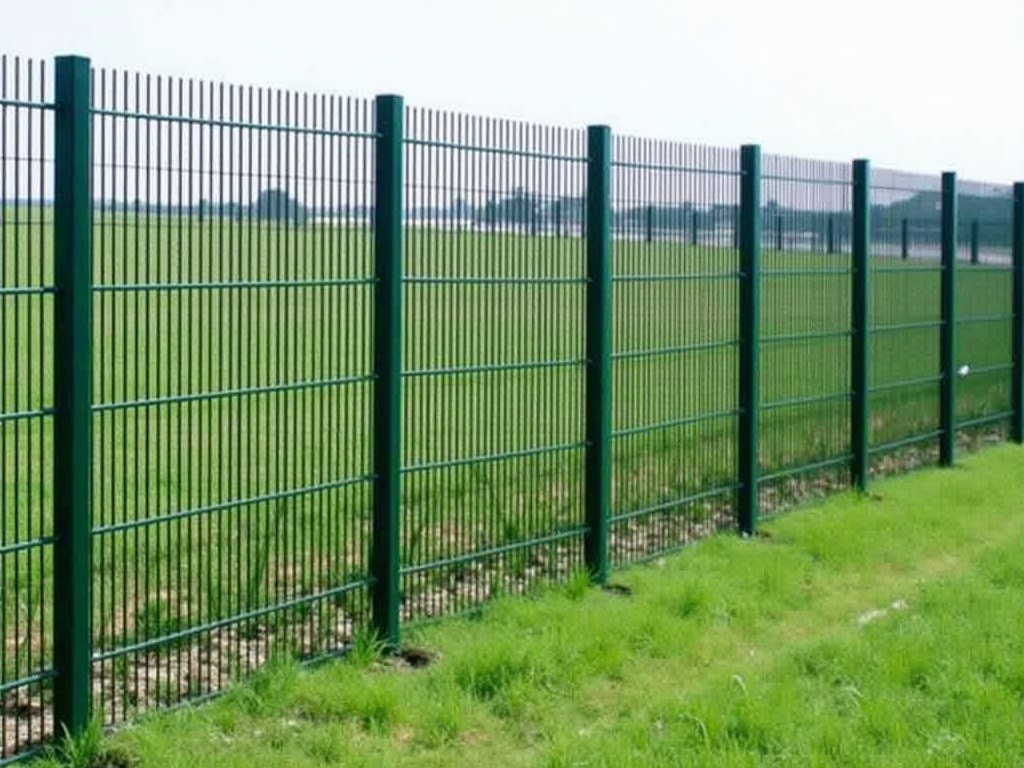
China Decorative Galvanized Wire Fencing Manufacturer
Decorative galvanized wire fencing combines corrosion‑resistant steel wire with ornamental patterns to provide both security and visual appeal for perimeter enclosures. The product is manufactured by
Request a QuoteChina Decorative Galvanized Wire Fencing Manufacturer
Decorative galvanized wire fencing combines corrosion‑resistant steel wire with ornamental patterns to provide both security and visual appeal for perimeter enclosures. The product is manufactured by drawing low‑carbon steel wire, applying a hot‑dip zinc coating, and forming the wire into mesh or welded panels with decorative tops.
Material and Construction Details
The base wire is typically low‑carbon steel with a diameter ranging from 1.2 mm to 3.0 mm, selected according to required tensile strength and flexibility. Hot‑dip galvanizing applies a zinc layer whose weight is measured in grams per square metre per side; common specifications are 200 g/m², 275 g/m², or 350 g/m² to achieve varying service lives in different atmospheres. After coating, the wire is either woven into a hexagonal mesh, welded into a square grid, or fabricated into ornamental patterns such as scroll‑top or spear‑top designs.
Technical Specifications
Standard rolls are supplied in heights from 0.9 m to 2.4 m and lengths of 10 m, 20 m, or 30 m per roll, with custom lengths available upon request. The following table lists typical values for key parameters; actual values can be adjusted to match project requirements.
| Parameter | Typical Range | Unit |
|---|---|---|
| Wire diameter | 1.2 – 3.0 | mm |
| Zinc coating weight | 200 – 350 | g/m² (each side) |
| Mesh opening (woven) | 25 – 100 | mm |
| Welded panel pitch | 50 – 150 | mm |
| Tensile strength of wire | 350 – 550 | MPa |
| Standard roll height | 0.9 – 2.4 | m |
| Standard roll length | 10 – 30 | m |
Typical Applications
Residential perimeter fencing benefits from the decorative tops that deter climbing while maintaining a neighbourhood‑friendly appearance. Commercial sites such as warehouses and office complexes use the fence for clear demarcation and low‑maintenance corrosion resistance.
Public parks and recreational areas select ornamental mesh patterns to integrate with landscaping while providing a barrier against unauthorized access. Agricultural installations employ the product for livestock containment where a balance of strength and visual openness is required.
Quality Control Philosophy
Each production lot undergoes coating adhesion testing using the ASTM D3359 tape method to verify that the zinc layer remains bonded after forming. Tensile strength is measured on sampled wire strands with a universal testing machine, recording yield and ultimate values.
Dimensional checks include wire diameter, mesh opening, and roll width, performed with calibrated calipers and laser scanners to maintain tolerances within ±0.05 mm. Visual inspection identifies surface defects such as bare spots, uneven coating, or deformation before packaging.
Customization Options
- Wire gauge selection from 1.2 mm to 3.0 mm to match load requirements.
- Mesh geometry: hexagonal woven, square welded, or custom ornamental patterns.
- Height adjustments in 0.1 m increments up to 3.0 m.
- Length customization for roll‑based or panel‑based delivery.
- Optional polymer overcoat in colours such as green, brown, or black for additional UV protection.
- Top finishes including scroll‑top, spear‑top, or flat‑edge configurations.
Packaging and Shipping
Fence rolls are wound onto a steel or wooden core with a diameter of 50 mm, then wrapped in UV‑stabilized polyethylene film to protect against moisture and abrasion during transit. Each roll is placed on a pallet, secured with strapping, and labeled with product code, dimensions, and batch number.
Standard 20‑foot containers accommodate approximately 220 rolls of 1.2 m height, while 40‑foot containers double that capacity, allowing efficient bulk shipment to overseas destinations.
Frequently Asked Questions
- Can the wire diameter and zinc coating be adjusted for specific corrosive environments?
- What information is required to receive a quotation (height, length, mesh type, coating weight, quantity)?
- Are samples available, and what is the lead time for sample preparation?
- How is quality verified before shipment (test reports, inspection certificates)?
- What packaging methods are used to prevent damage during long‑distance transport?
Contact for Technical Inquiry
To discuss project‑specific requirements, request a quotation, or obtain samples, please reach out via the contact form. Our technical team will respond with detailed specifications and lead‑time information.



