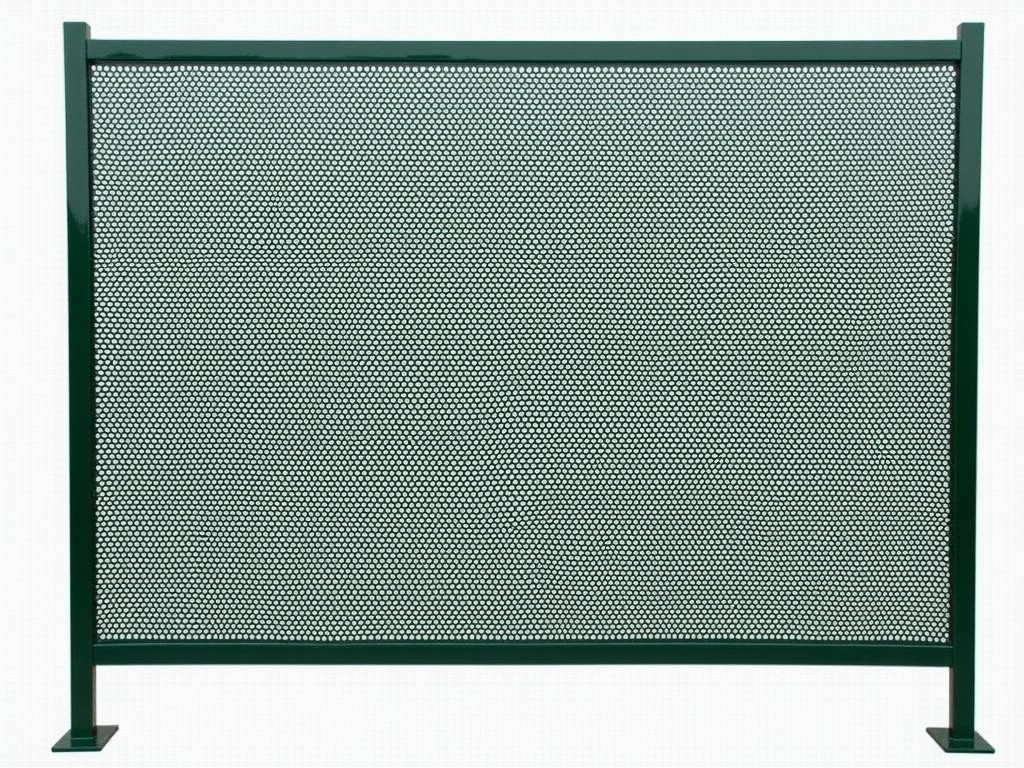
Buy Perforated Metal Fence Panels
Perforated metal fence panels are fabricated from sheet metal that has been punched with a regular array of holes to achieve specific open‑area percentages while retaining structural integrity. The
Request a QuoteBuy Perforated Metal Fence Panels
Product Overview
Perforated metal fence panels are fabricated from sheet metal that has been punched with a regular array of holes to achieve specific open‑area percentages while retaining structural integrity. The hole pattern, diameter, and pitch directly influence airflow, visibility, and load‑bearing capacity.
Typical base materials include cold‑rolled steel, hot‑rolled galvanized steel, stainless steel (grades 304/316), and aluminum alloys. Panel thickness commonly ranges from 0.8 mm to 3.0 mm, selected according to required wind load resistance and impact durability.
Material Specifications
Material choice affects corrosion resistance, weight, and cost. The following table lists typical mechanical and chemical properties for the most frequently supplied options.
| Property | Cold‑rolled Steel | Hot‑dip Galvanized Steel | Stainless Steel 304 | Aluminum 5052 |
|---|---|---|---|---|
| Tensile Strength (MPa) | 350–550 | 350–550 | 520–720 | 190–260 |
| Yield Strength (MPa) | 250–350 | 250–350 | 215–290 | 110–180 |
| Density (g/cm³) | 7.85 | 7.85 | 8.00 | 2.68 |
| Typical Coating | None (oil‑protected) | Zn 55‑85 µm | Passive Cr‑oxide | Anodized or mill finish |
Hole patterns are defined by center‑to‑center pitch (p) and hole diameter (d). Open area (OA) is calculated as OA = (π × (d/2)² ÷ p²) × 100 %. Common OA values for fence panels range from 15 % to 45 %, balancing visibility with structural stiffness.
Design and Engineering
Panel dimensions are typically manufactured in widths of 600 mm to 1200 mm and lengths up to 6000 mm, limited by press brake capacity and transportation logistics. Edge treatments include folded flanges, welded frames, or slip‑on brackets for modular installation.
The table below shows standard configurations that meet typical wind load requirements for perimeter security fencing in industrial zones (basic gust speed 30 m/s). Custom sizes are available upon request.
| Width (mm) | Thickness (mm) | Hole Dia. (mm) | Pitch (mm) | Open Area (%) | Estimated Weight (kg/m²) |
|---|---|---|---|---|---|
| 800 | 1.2 | 8 | 20 | 12.6 | 9.4 |
| 1000 | 1.5 | 10 | 25 | 15.7 | 11.8 |
| 1200 | 2.0 | 12 | 30 | 18.8 | 15.7 |
Deflection under uniform load is limited to L/200 for serviceability, where L is the span between posts. Designers should verify local codes for post spacing and foundation depth.
Industrial Applications
Perforated fence panels serve functional roles beyond simple demarcation. In manufacturing facilities, they provide machine guarding while allowing coolant spray and chip evacuation. In power substations, the panels deter unauthorized access yet permit infrared thermography surveys without removal.
Transportation hubs use them for noise attenuation; the hole pattern disrupts sound waves, reducing transmitted noise by up to 8 dB depending on open area and mounting depth. Agricultural installations benefit from controlled airflow that reduces condensation on stored produce while preventing animal intrusion.
- Machine Guarding: Maintains visibility for operators while containing debris.
- Substation Security: Enables thermal imaging inspections without panel removal.
- Noise Barriers: Perforation geometry attenuates mid‑frequency traffic noise.
- Agricultural Enclosures: Provides ventilation and pest exclusion.
Customization Options
Customization begins with material selection and extends to hole geometry, surface treatment, and framing. Clients often specify a particular open area to match HVAC intake requirements or to achieve a desired visual transparency.
- Hole shapes: round, square, slotted, hexagonal, decorative patterns.
- Surface finishes: powder coating (RAL colors), hot‑dip galvanizing, anodizing, passivation.
- Edge treatments: hemmed, flanged, welded angle frames, slide‑in channels.
- Mounting provisions: pre‑drilled post brackets, slip‑on clamps, welded studs.
- Additional features: integrated lockable gates, anti‑climb toppings, UV‑stable pigments.
All custom parameters are reviewed for structural feasibility; for example, increasing hole diameter beyond 40 % of pitch may necessitate a thickness increase to maintain buckling resistance.
Quality Control and Testing
Each production lot undergoes dimensional verification, hole‑pattern registration, and material thickness checks using calibrated laser micrometers. Visual inspection confirms burr‑free edges and uniform coating adhesion.
Mechanical tests include tensile strength per ASTM E8/E8M and hardness measurement (Rockwell B) to validate material grade. For coated panels, salt‑spray exposure (ASTM B117) is performed for 500 hours to assess corrosion resistance; acceptance criteria specify less than 5 % red rust area.
Final product validation involves a load‑deflection test on a simply supported panel spanning 1200 mm, confirming that deflection does not exceed L/200 under a uniformly distributed load of 1.5 kN/m², representative of typical wind pressure for industrial fencing.
Packaging and Shipping
Panels are stacked on pallets with interleaving corrugated cardboard or polyethylene sheets to prevent surface abrasion. Edge protectors are applied to all four sides, and the entire unit is secured with polyester strapping.
Standard export packaging complies with ISPM 15 for wooden pallets; for overseas shipments, a moisture‑barrier wrap and desiccant packs are included to mitigate condensation during transit. Each pallet is labeled with part number, material grade, hole pattern, and quantity.
Lead time varies from 2 weeks for stocked specifications to 4‑6 weeks for custom hole patterns or special coatings, contingent on raw material availability and press capacity.
Frequently Asked Questions
Can dimensions be customized to match existing post spacing?
Yes. Width, length, and hole pitch can be adjusted within press brake limits; please provide the required span and load conditions for a feasibility review.
What information is needed before a quotation?
Material grade, thickness, desired hole diameter and pattern (or open‑area percentage), panel dimensions, edge treatment, surface finish, and quantity. A sketch or DXF file accelerates the process.
Which materials are available for corrosive environments?
Hot‑dip galvanized steel, stainless steel grades 304/316, and aluminum alloys with suitable coatings are standard options; alternative alloys such as duplex stainless steel can be sourced upon request.
How is quality inspected before shipment?
Each lot undergoes dimensional checks, visual surface inspection, mechanical testing (tensile, hardness), and, for coated products, salt‑spray corrosion testing per ASTM B117.
What packaging methods protect panels during transport?
Panels are stacked on pallets with interleaving protective sheets, edge guards, and secured with strapping. Export shipments include moisture‑barrier wrap and desiccant packs.
Contact for Quote
To receive a detailed quotation, please provide your project specifications using the form below. Our engineering team will review the requirements and return a formal proposal with lead time and pricing.
Request a Quote


