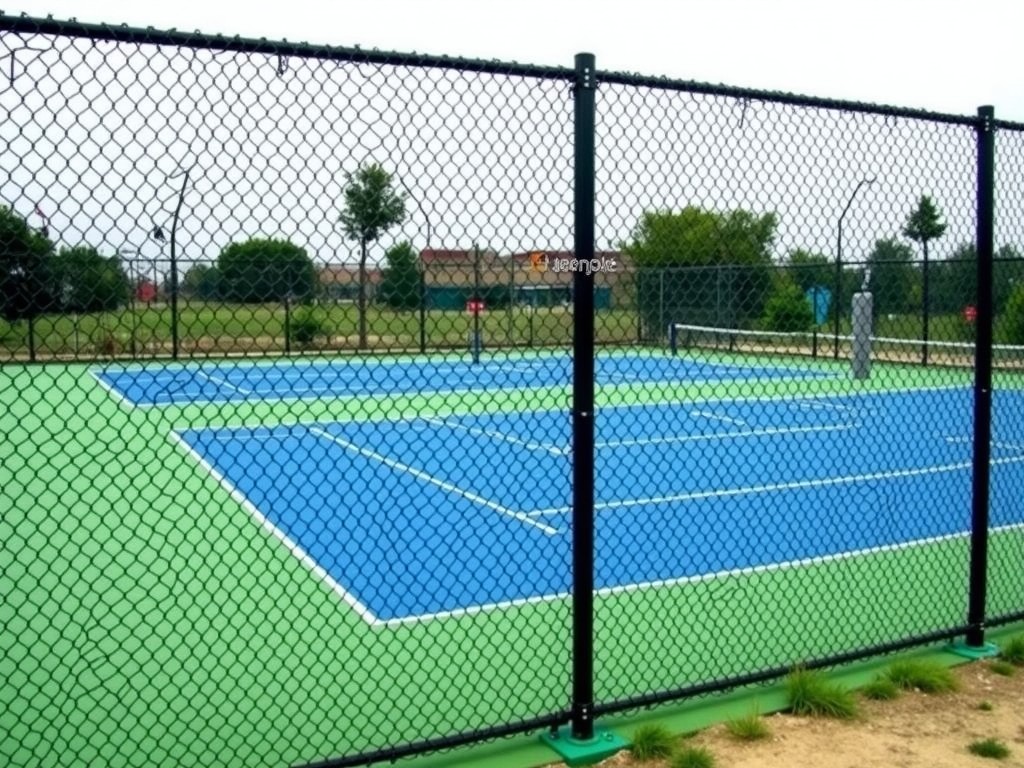
Best Price Tennis Court Chain Link Fence Price Manufacturer
A tennis court chain link fence consists of steel wire woven into a diamond mesh, then coated to resist corrosion. The open structure provides clear sightlines for players and spectators while
Request a QuoteTennis Court Chain Link Fence – Manufacturer Overview
A tennis court chain link fence consists of steel wire woven into a diamond mesh, then coated to resist corrosion. The open structure provides clear sightlines for players and spectators while containing balls within the playing area.
Because the mesh allows air to pass, wind loads on the fence are lower than on solid barriers, reducing stress on posts and foundations. The coating protects the steel from moisture and UV exposure, extending service life in outdoor sports environments.
Technical Specifications
| Parameter | Typical Value | Notes / Customization |
|---|---|---|
| Wire diameter | 2.0 mm – 3.0 mm | Available in intermediate sizes; thicker wire increases tensile strength. |
| Mesh opening | 45 mm × 45 mm (standard) | Alternative openings (30 mm, 60 mm) affect ball retention and visibility. |
| Fence height | 2.4 m – 3.6 m | Height selected based on court regulations and surrounding barriers. |
| Post spacing | 2.5 m – 3.0 m | Closer spacing reduces deflection under wind load. |
| Coating type | Hot‑dip galvanized, PVC‑coated, or powder‑coated | PVC thickness typically 0.4 mm – 0.6 mm; galvanization 60 g/m² – 120 g/m². |
| Tensile strength of wire | ≥ 350 MPa | Ensures resistance to sagging and impact from balls. |
Typical Applications in Tennis Facilities
Tennis courts require a barrier that stops balls from leaving the play area while preserving an unobstructed view of the game. The diamond mesh of chain link fencing meets both criteria because the openings are small enough to retain standard tennis balls yet large enough to allow clear sightlines.
In addition to perimeter containment, the fence is often used around practice walls, ball‑machine enclosures, and spectator walkways. Its low visual mass helps maintain the open feel of the facility while still providing a defined boundary.
Manufacturing and Quality Control
Production begins with cold‑drawn steel wire that is drawn to the specified diameter, then cleaned and passed through a hot‑dip galvanizing bath to apply a zinc layer. After galvanizing, the wire may be extruded with PVC or passed through a powder‑coating line for additional color and UV protection.
The coated wires are woven on a loom to form the diamond mesh, with tension controlled to keep the opening dimensions uniform. Posts are fabricated from tubular steel, punched for mesh attachment, and coated using the same process as the mesh to ensure galvanic compatibility.
Quality checks include visual inspection of coating continuity, measurement of wire diameter and mesh opening, adhesion testing of the PVC layer (cross‑hatch test), and verification of post straightness and hole alignment. Each batch is documented before release.
Customization Options
- Wire diameter: 2.0 mm, 2.5 mm, 3.0 mm
- Coating: hot‑dip galvanized only, galvanized + PVC, or powder‑coated in RAL colors
- Mesh opening: 30 mm, 45 mm, 60 mm
- Height: 2.4 m to 4.2 m in 0.3 m increments
- Post type: round Ø 60 mm, square 50 mm × 50 mm, with optional base plates
- Accessories: top rail, tension wire, gate kits, ground spikes, and concrete footings
Cost Considerations
The primary drivers of price are the wire gauge and coating thickness; heavier wire and thicker PVC increase material cost and processing time. Height and length affect the total weight of steel and coating, while closer post spacing adds more posts and hardware.
Order volume influences unit pricing because coil‑drawing, galvanizing, and weaving lines have setup efficiencies at higher quantities. Additional features such as powder‑coating, custom colors, or integrated gates add incremental costs that are quoted per specification.
For accurate budgeting, provide the desired wire diameter, coating type, height, total linear length, post spacing, and any required accessories. The manufacturer can then calculate material usage, labor, and surface‑treatment costs based on those inputs.
Frequently Asked Questions
Can the fence height be adjusted after installation?
Height is set during fabrication; altering it on site would require cutting the mesh and re‑tensioning, which may compromise coating integrity. It is recommended to select the final height before production.
What information is needed for a quotation?
Provide wire diameter, coating preference (galvanized, PVC, powder), mesh opening, overall height, total length, post spacing, and any accessories such as gates or top rails. A simple sketch or CAD file helps confirm post placement.
How is the coating quality verified?
Coating thickness is measured with a magnetic‑induction gauge for zinc and a micrometer for PVC. Adhesion is tested using a cross‑hatch method per ASTM D3359. Results are recorded in the batch test report.
What packaging methods protect the finish during transit?
Rolls are wrapped in polyethylene film, placed on pallets, and secured with corner protectors. For long‑distance shipments, additional edge boards and moisture‑absorbing packets are used to prevent scratching and corrosion.
What is the typical lead time for a standard order?
Lead time ranges from 3 to 5 weeks depending on coating type and order volume. Expedited options are available for projects with critical schedules, subject to production capacity.
Request a Quote
To receive a detailed quotation, share your project specifications via the contact form. Our engineering team will review the requirements, confirm material selections, and provide a itemized price breakdown.



