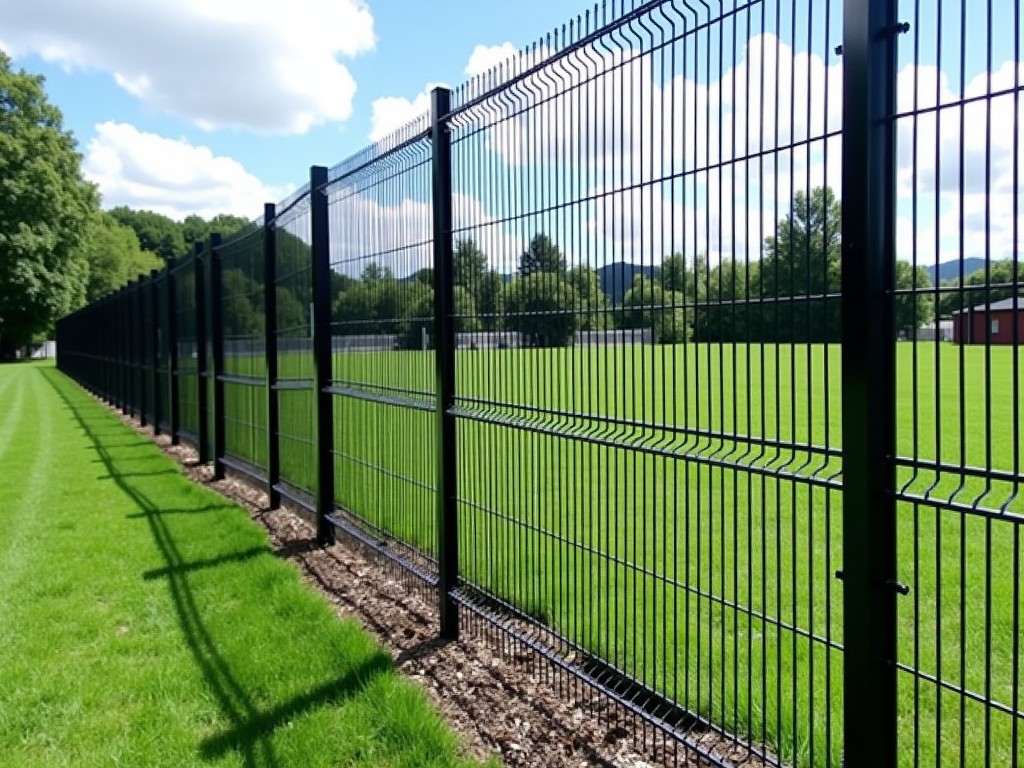
B2B Outdoor Metal Fence Panels Manufacturer
Our facility produces welded and interlocking fence panels made from hot‑dip galvanized steel, suitable for perimeter security, industrial sites, and municipal infrastructure. Panels are fabricated
Request a QuoteB2B Outdoor Metal Fence Panels Manufacturer
Our facility produces welded and interlocking fence panels made from hot‑dip galvanized steel, suitable for perimeter security, industrial sites, and municipal infrastructure. Panels are fabricated to ASTM A123 coating standards and can be supplied in lengths ranging from 2 m to 6 m with post spacing options of 2.5 m or 3 m.
Material Selection and Coating Options
Base material is structural grade steel (S235JR) with a minimum yield strength of 235 MPa. After forming, panels undergo hot‑dip galvanization achieving a zinc coating weight of 275 g/m² (≈20 µm thickness) per EN ISO 1461. For coastal or high‑humidity environments, a duplex system adds a powder‑coat polyester top layer (60 µm) providing additional UV resistance.
- Hot‑dip galvanized only (standard)
- Galvanized + polyester powder coat (custom color)
- Galvanized + epoxy primer for chemical exposure
Typical Dimensional and Mechanical Properties
| Parameter | Typical Value | Notes |
|---|---|---|
| Panel height | 1.2 m – 2.4 m | Custom heights available on request |
| Panel width (clear opening) | 2.0 m – 6.0 m | Standard increments of 0.5 m |
| Wire diameter (vertical) | 4.0 mm – 6.0 mm | Determines wind load resistance |
| Horizontal rail size | 50 mm × 50 mm × 3.0 mm tube | Provides bending stiffness |
| Weight per square meter | 12 kg/m² – 18 kg/m² | Depends on height and wire gauge |
Design Features for Structural Performance
Vertical wires are welded to horizontal rails at every intersection, creating a rigid grid that distributes impact loads. The weld penetration is maintained at ≥0.6 mm to ensure shear strength exceeding 1.5 kN per joint. Panels include pre‑drilled flange plates (Ø 12 mm) at 150 mm intervals for quick bolt‑on to C‑channel or H‑section posts.
Wind load calculations follow ASCE 7‑16; a 2.4 m high panel with 5 mm wire sustains a basic wind speed of 45 m/s (≈100 mph) without permanent deformation when installed with recommended post embedment depth of 0.6 m in concrete.
Common Applications and Rationale
Industrial facilities select these panels for perimeter demarcation because the open‑grid design reduces wind pressure while maintaining visual deterrence. Municipalities use them around water treatment plants where the galvanized coating resists corrosion from chlorine‑laden atmospheres. Data centers prefer the powder‑coated variant to match site aesthetics and avoid reflective glare that could interfere with surveillance optics.
Customization Workflow
Customers provide site‑specific parameters: required height, length, wind zone, and coating preference. Our engineering team returns a CAD layout showing post locations, panel counts, and accessory parts (tension bars, ground spikes). Tolerances are held to ±2 mm on cut lengths and ±0.5 mm on hole diameters to ensure field fit‑up without re‑drilling.
Quality Assurance and Testing
Each batch undergoes coating thickness measurement via magnetic induction (minimum 5 readings per panel). Visual inspection checks for weld porosity, undercut, and spatter. Mechanical testing includes tensile strength of wire samples (target ≥450 MPa) and shear tests on welded joints. Documentation includes mill test reports, coating certificates, and a traceability tag affixed to every panel.
Packaging and Export Protection
Panels are stacked flat on wooden pallets (max height 1.2 m) with polyethylene interleaving to prevent surface abrasion. Corner protectors and steel straps secure the load. For overseas shipments, pallets are fumigated and wrapped in UV‑stable stretch film; a desiccant packet controls moisture inside the container.
Frequently Asked Questions
- Can dimensions be customized? Yes, height, width, and wire gauge are adjusted per project specs; tooling changes apply for non‑standard profiles.
- What information is needed for a quotation? Provide panel height, total linear length, wind zone (or basic wind speed), coating type, and post material preference.
- How is quality inspected before shipment? Each panel receives coating thickness verification, visual weld inspection, and mechanical test sampling per lot.
- What packaging options exist for domestic vs. export? Domestic orders use palletized stretch‑film; export orders add fumigation, desiccant, and reinforced strapping.
- What is the typical lead time? Standard galvanized panels ship in 3‑4 weeks; coated finishes add 1‑2 weeks for curing.



